


Solo knowledge workers face an invisible operating dilemma: when you manage yourself, you are simultaneously the strategic executive, the frontline builder, and the quality assurance tester. Without external anchors, workdays easily dissolve into fragmented context-switching, reactive inbox firefighting, and lingering guilt over unfinished tasks.
Adopting a structured personal daily sprint framework replaces this uncertainty with calm operational clarity. By taking the agile ceremonies popularized by software teams and tailoring them to an individual workday, you build an airtight system that protects your cognitive energy and guarantees high-impact completion before your evening begins.
What Is a Personal Daily Sprint?
In classical product development, a sprint is a fixed timebox where a team commits to finishing a concrete batch of work. According to foundational agile standards documented by Scrum.org, the decisive advantage of a sprint is scope lock: once the cycle begins, new requests cannot penetrate the backlog until the current increment ships.
A personal daily sprint applies this exact discipline to a single eight-hour working window. Instead of maintaining an endless to-do list with twenty competing items, you select one to three high-leverage deliverables. You plan your capacity in the morning, lock your active queue, execute in dedicated deep work blocks, and shut down with a structured retrospective.
The Golden Rule of Solo Sprints:
Once your morning sprint goal is locked, new incoming tasks, client messages, or spontaneous project ideas cannot enter today’s queue. They are logged in an inbox triage board for tomorrow’s planning cycle.
The 4 Phases of the Personal Daily Sprint
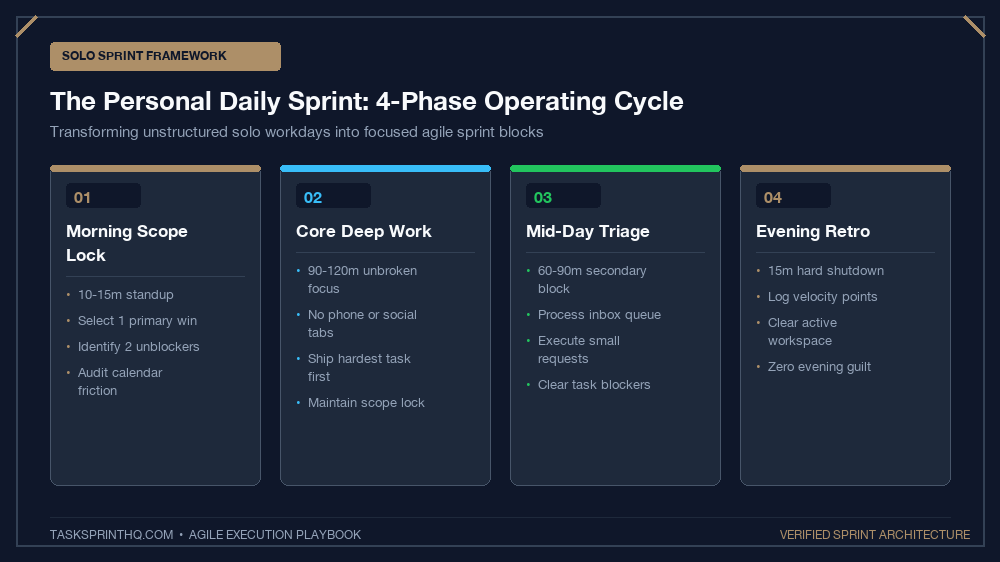
To run your sprint smoothly without mental exhaustion, structure your daily workflow into four predictable operational phases:
Phase 1: Morning Standup & Scope Lock (10–15 Minutes)
Start your morning before opening email, Slack, or social feeds. Open your sprint log and answer three essential questions:
- The Primary Objective: What single deliverable will make today a decisive operational win?
- Supporting Milestones: What two secondary tasks are strictly required to unblock progress?
- Calendar Friction: What scheduled calls or administrative meetings will restrict my focus hours?
During this stage, estimate your available deep work hours accurately. If you need help sizing your realistic energy bandwidth, review our guide on daily sprint capacity calculation to avoid overcommitting early in the week.
Phase 2: The Core Deep Work Block (90–120 Minutes)
Dedicate your peak cognitive window—usually mid-morning—exclusively to your primary objective. Close browser tabs, place your smartphone in another room, and silence all non-emergency desktop alerts. If you work best with structured intervals, apply our proven techniques from timeboxing vs Pomodoro for deep work to maintain unbroken concentration.
Phase 3: The Mid-Day Triage & Secondary Sprint (60–90 Minutes)
After your core deliverable is substantially finished or safely staged, open your communication channels. Batch-process pending messages, answer client emails, and execute your two secondary sprint items. Because your main deliverable is already accomplished, handling administrative items carries zero anxiety.
Phase 4: Sprint Retrospective & Daily Shutdown (15 Minutes)
At the end of your scheduled day, run a disciplined shutdown sequence. Evaluate what was completed, note any recurring bottlenecks, and clear your desktop workspace. A clean closure signals to your nervous system that work has ended.
Personal Sprint vs. Traditional To-Do List
Understanding the fundamental differences between an unconstrained task list and a disciplined solo sprint illustrates why sprints consistently produce superior outcomes:
| Dimension | Traditional To-Do List | Personal Daily Sprint |
|---|---|---|
| Scope Boundary | Open-ended, grows continuously throughout the day | Strictly locked after the morning planning ritual |
| Prioritization | Weak; users default to simple low-friction tasks | Forced hierarchy: 1 primary goal, 2 secondary tasks |
| Energy Management | Assumes constant 8-hour cognitive stamina | Aligns core tasks with peak morning energy windows |
| Psychological Closure | Low; unfinished items trigger chronic end-of-day guilt | High; deliberate shutdown ritual creates clear boundaries |
How to Set Up Your Daily Sprint Board
You do not need sophisticated enterprise project management suites to organize a solo sprint. A basic physical whiteboard or a streamlined digital board with four columns delivers optimum results:
- Backlog: The central holding pen for every project idea, client request, and future to-do item.
- Today’s Sprint (Max 3): Your locked daily commitments chosen during the morning standup.
- In Progress (Strict WIP Limit 1): The exact task currently open on your monitor. Multitasking is strictly forbidden.
- Done: Finished deliverables that validate your daily momentum.
Work-In-Progress (WIP) Rule:
Never allow more than one card into “In Progress”. If an unexpected blocker arises, either resolve it immediately or push the card back to Backlog before pulling a replacement.
Common Solo Sprint Pitfalls and How to Avoid Them
While the sprint methodology is straightforward, freelancers and remote professionals frequently stumble over three predictable hurdles:
1. Overestimating Daily Focus Capacity
Most knowledge workers overestimate how many hours of intense deep work their brains can sustain. Research demonstrates that four to five hours of genuine deep concentration is the natural cognitive ceiling. If you schedule eight hours of difficult creative work into a single day, your sprint will collapse by mid-afternoon.
2. Allowing Scope Creep via Urgent Inquiries
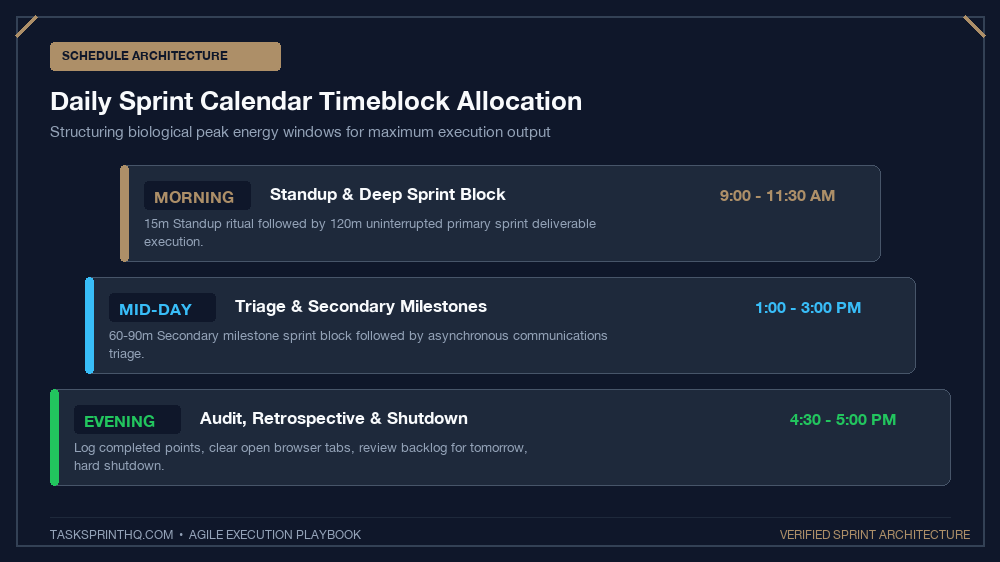
When an urgent client email arrives at 11:00 AM, the instinct is to drop your sprint goal immediately. Unless a server is down or a critical contract is expiring, 95% of incoming messages can wait until your scheduled afternoon triage block. Establishing this communication buffer preserves momentum.
3. Skipping the Daily Retrospective
Ending work abruptly without documenting what happened robs you of valuable operational feedback. Spending just five minutes recording whether your time estimates were accurate enables you to calibrate tomorrow’s sprint with surgical precision.
Frequently Asked Questions About Solo Sprints
Can I run a daily sprint if my schedule is full of client meetings?
Yes. On days heavy with meetings, simply calibrate your sprint goal downward. Instead of choosing a complex three-hour deliverable, define a focused 45-minute task—such as outlining a client proposal—as your primary win. Sprints adapt to your calendar, not the other way around.
What if I fail to finish my locked sprint goal?
Treat unfinished sprint items as diagnostic data rather than personal failure. Ask yourself why the goal stalled: Was the scope too broad? Did unexpected dependencies emerge? Break the remaining work into smaller micro-milestones for tomorrow’s sprint.
Start Your First Sprint Tomorrow Morning
Transitioning to a personal daily sprint framework does not require complicated software or drastic life overhauls. Tonight, clean your physical desk and close lingering browser tabs. Tomorrow morning, before opening your inbox, write down your single primary objective, commit your focus hours, and discover the calm productivity of sprint-driven focus.