

Daily 15-minute video standup meetings are one of the most expensive productivity leaks in modern remote organizations. For distributed teams spread across multiple timezones, forcing eight engineers, designers, and managers into a synchronized Zoom room interrupts deep work, forces awkward early morning or late night calls, and degenerates into status recitation that nobody remembers an hour later.
Replacing synchronous status calls with a disciplined 3-bullet asynchronous daily update template restores uninterrupted cognitive focus while providing managers with a searchable, permanent audit trail of team progress.
The Flaw of Unstructured Slack Check-Ins
When remote teams attempt to transition away from live standups, they frequently fall into a second trap: chaotic Slack channels where team members dump rambling paragraphs, unformatted code snippets, and vague updates like ‘Worked on backend tickets today.’
According to remote operations handbooks published by GitLab, effective asynchronous communication requires predictable information architecture. An asynchronous update must be scannable in under ten seconds and explicitly highlight blockers before they become project delays.
The 3-Bullet Async Framework
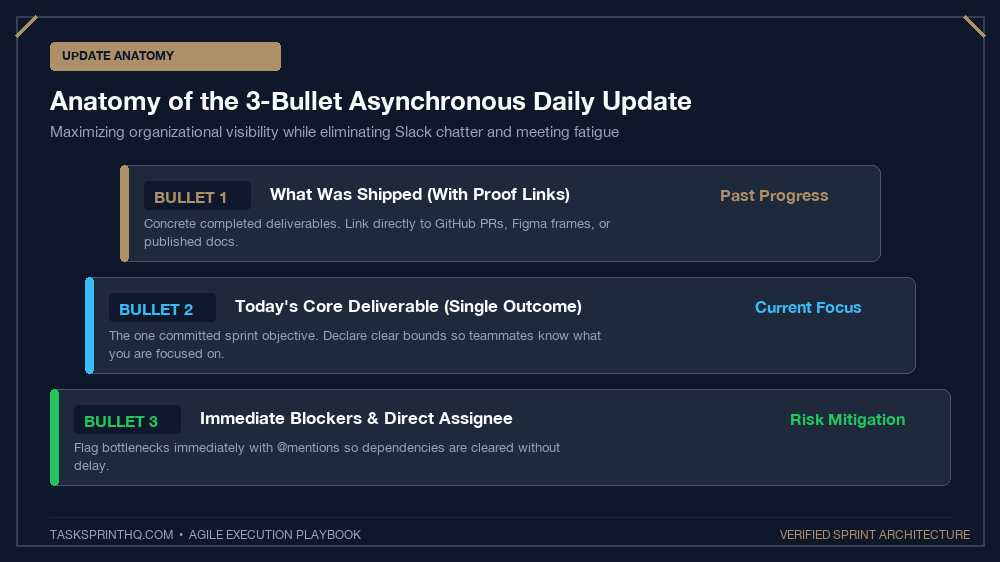
Every team member posts a single message per working day adhering to this exact 3-bullet syntax:
🟢 SHIPPED: [Concrete deliverable completed in yesterday’s sprint with link/ticket]
🎯 TARGET: [Single primary deliverable committing to today with estimated completion time]
🔴 BLOCKED: [Specific dependency, missing asset, or ‘None’ with @mention of owner]
Anatomy of an Effective Async Update vs Weak Update
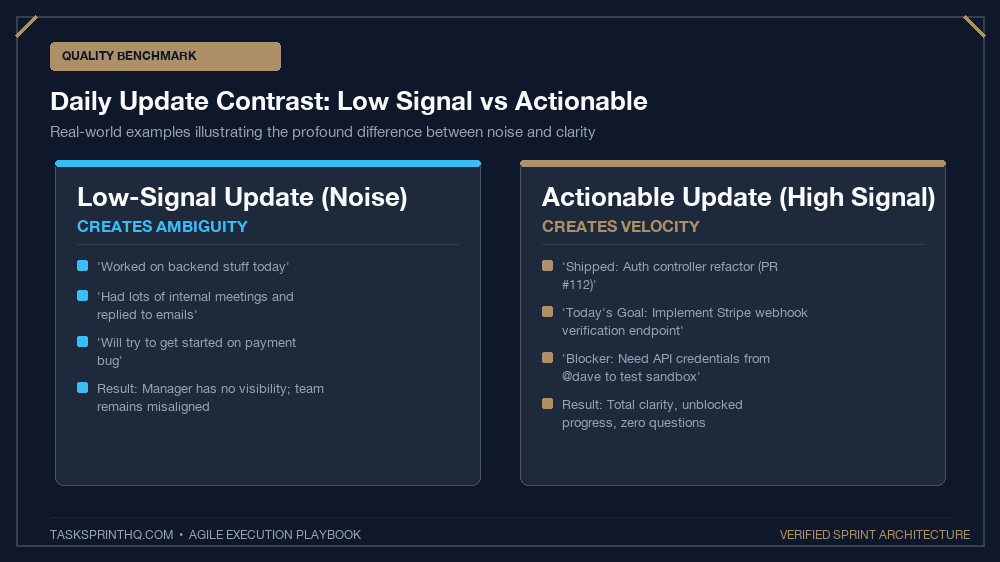
| Element | Vague Unhelpful Update | Disciplined 3-Bullet Async Update |
|---|---|---|
| Shipped Item | ‘Worked on login page styles.’ | 🟢 SHIPPED: Merged PR #241 (OAuth2 Auth0 button styling). |
| Today’s Target | ‘Will look into billing bugs.’ | 🎯 TARGET: Fix Stripe webhook retry timeout on ticket #184 by 3 PM PST. |
| Blockers | ‘Waiting on design team.’ | 🔴 BLOCKED: Need final SVG export for hero icon from @sarah before merging. |
Automating the Workflow: Channel Hygiene Rules
To prevent notification fatigue, enforce these four operational rules across your communication tools:
- Dedicated Standup Channel: Confine daily updates to a channel named
#async-standupor#daily-sprint-log. For setup details, see our tutorial on replacing daily standup meetings with Slack workflows. - Thread Discipline: Team members must never reply in the main channel. Any discussion or troubleshooting must occur in the thread beneath the author’s update.
- Zero Real-Time Expectation: Updates are submitted by each member at the start of their local working day. Nobody is expected to read updates outside their business hours.
- Cross-Timezone Handoffs: When handing off work to colleagues eight hours ahead, pair your daily update with our async handoff checklist for distributed teams.
Why Distributed Teams Burn Out on Synchronous Standups
The original Scrum standup was designed for five co-located software developers standing in a physical circle for ten minutes before beginning work. When remote companies transplant this ceremony into digital workspaces, the results are disastrous:
- Timezone Exploitation: In global organizations, someone is always forced to attend at 7:00 AM or 9:30 PM, disrupting personal circadian cycles and family commitments.
- The Pre-Meeting Void: Knowledge workers experience cognitive paralysis 45 minutes before a scheduled call, unwilling to start complex code or creative briefs knowing they will be interrupted.
- Zero Retrievable Memory: Verbal status recitations vanish into thin air. If a product manager misses the call, they must ping developers individually to learn what happened.
Deep Dive: The 3 Bullets Explained with Linguistic Precision
To make the 3-bullet asynchronous daily update work across teams of 5 to 500 people, enforce strict linguistic formatting standards for each line:
Bullet 1: 🟢 SHIPPED (Verifiable Evidence)
The first bullet must never state intention; it states completed, verifiable reality. Always include a markdown hyperlink to the finished artifact:
- Bad: ‘Worked on checkout bug.’
- Good: ‘🟢 SHIPPED: Resolved cart total rounding discrepancy on ticket #412 (merged into staging branch).’
- Good: ‘🟢 SHIPPED: Published Q3 Retention Playbook draft in Notion with team comments addressed.’
Bullet 2: 🎯 TARGET (Single Primary Deliverable)
Do not list five things you hope to achieve. Declare the single milestone that represents operational victory today. Include an estimated completion timestamp in your local timezone:
- Bad: ‘Will do emails, client calls, and start the new database migration.’
- Good: ‘🎯 TARGET: Finalize user authentication middleware by 3:30 PM CET.’
Bullet 3: 🔴 BLOCKED (Direct Ownership Tagging)
Blockers must be accompanied by an actionable request and an @mention of the directly responsible individual (DRI):
- Bad: ‘Waiting on design approval.’
- Good: ‘🔴 BLOCKED: Need final color hex values from @alex for dark mode banner before PR review.’
- If Unblocked: Explicitly write
🔴 BLOCKED: None. This confirms the team member has audited their workflow and possesses everything needed to execute.
How Team Leads Review 20 Updates in Under 10 Minutes
For engineering managers and team leads, auditing asynchronous updates requires a disciplined triage scan:
- Open the
#daily-standupchannel at 10:30 AM local time. - Scan exclusively for the 🔴 BLOCKED red emoji. If a team member is blocked, immediately step in via thread to clear the dependency, tag the responsible peer, or adjust sprint priorities.
- Verify that the 🎯 TARGET align with current sprint goals. If someone commits to low-impact tasks outside the active sprint, gently redirect them back to the committed backlog.
- React with a simple acknowledgment emoji (e.g., 👀 or 👍) so the contributor knows their update was seen. For meeting reduction strategies, check our guide on cutting weekly team meetings by 50%.
Frequently Asked Questions
How do managers hold team members accountable without live standups?
Accountability shifts from physical seat time to verifiable output. The 🟢 SHIPPED bullet links directly to PRs, Figma links, or ticket completions that speak for themselves.
What time of day should async updates be submitted?
Updates should be posted within the first 30 minutes of each team member’s local workday, rather than at a fixed universal hour.
What happens if someone has no blockers?
They explicitly write ‘🔴 BLOCKED: None’. Leaving the line blank creates ambiguity about whether blockers were considered.
Should we use Slack bots like Geekbot or simple manual posts?
Automated Slack bots help remind distributed team members across different timezones, but manual posts work equally well with zero software costs.
Does asynchronous communication reduce team cohesion?
When daily status noise is removed, teams have more cognitive energy for deliberate social calls, monthly retrospectives, and genuine collaboration.