


Knowledge workers struggling with task paralysis typically encounter two contrasting recommendations: the radical analog minimalism of the 100-year-old Ivy Lee Method, or the rigorous schedule discipline of calendar timeboxing. Both frameworks promise to cure chronic procrastination and eliminate decision fatigue, yet they operate on diametrically opposed operational philosophies.
Understanding the exact mechanics of Ivy Lee Method vs Timeboxing allows you to select the right weapon for your specific cognitive style and professional workload, ensuring your priority system does not collapse the moment an unexpected email arrives.
The Ivy Lee Method: Ruthless Sequential Simplicity
Developed in 1918 by productivity pioneer Ivy Lee for Bethlehem Steel executives, this framework relies on six strict operating rules:

- At the conclusion of each workday, write down the six most important tasks you must accomplish tomorrow. Do not write seven.
- Rank those six items in strict order of their true operational importance (1 through 6).
- When you arrive at work tomorrow, concentrate exclusively on task #1. Do not move forward until it is complete.
- Approach the rest of your list in the exact same sequential fashion. If any tasks remain unfinished at day’s end, move them to tomorrow’s new list of six.
- Repeat this process every single business day.
The genius of Ivy Lee lies in cognitive reduction: it forces a single-track sequential focus and eliminates the morning dilemma of deciding what to work on.
Timeboxing: The Calendar-Backed Commitment
Timeboxing, widely endorsed in modern management research published by Harvard Business Review, takes task management and binds it directly to the fourth dimension: finite clock time.
Instead of maintaining a floating list of six items, you estimate task durations and convert them into concrete calendar events (e.g., 9:00 AM – 10:30 AM: Deep Work on Client Brief). The primary benefit of timeboxing is capacity realism: an item cannot exist on your schedule unless you allocate an unblocked block of real calendar minutes to support it.
Feature-by-Feature Comparison Matrix
| Core Dimension | Ivy Lee Method | Calendar Timeboxing |
|---|---|---|
| Time Awareness | None; tasks take as long as they take | High; tasks have rigid start and end boundaries |
| Setup Friction | Zero (pencil and an index card) | Moderate (requires calendar software or grid planner) |
| Handling Meeting Chaos | Poor (meetings disrupt sequential execution) | Excellent (meetings are native calendar blocks) |
| Decision Fatigue Shield | Maximum (you only ever look at task #1) | High (calendar tells you what to do each hour) |
| Best Work Environment | Autonomous solo creators with few meetings | Knowledge workers navigating shared team calendars |
The Hybrid ‘Ivy-Box’ Protocol:
You can combine both methods: Use the Ivy Lee rule to select exactly three (not six) priority items the night before. Then, timebox those three items into your morning calendar blocks from 9:00 AM to 1:00 PM. This gives you sequential clarity backed by calendar capacity.
When Ivy Lee Breaks Down in Practice
While the Ivy Lee Method is beautifully simple, modern professionals frequently encounter its fatal flaw: the Task #1 Bottleneck. If Task #1 encounters an unexpected blocker (e.g., waiting for client feedback or a vendor API token), strict adherence to Ivy Lee causes your entire workday to grind to an anxious halt. If you struggle with task bottlenecks, explore our comparison of Eat That Frog vs Eisenhower Matrix for dynamic prioritization rules.
When Timeboxing Breaks Down
Conversely, timeboxing fails when practitioners become overly rigid calendar accountants. Packing every 30-minute block from 8:00 AM to 5:00 PM leaves zero margin for human nature, leading to severe schedule collapse when a single morning call runs 15 minutes late. For step-by-step guidance on structuring flexible focus blocks, read our deep-dive on timeboxing vs Pomodoro for deep work.
The Psychological Foundations: 1918 vs 2026
In 1918, productivity consultant Ivy Lee gave Charles M. Schwab, president of Bethlehem Steel, advice that became legendary: write down the six most important tasks for tomorrow, rank them in strict numerical order, and work only on number one until finished. Schwab famously paid Lee a $25,000 check (equivalent to over $500,000 today) because the protocol produced immediate industrial output gains.
A century later, digital knowledge workers operate in an environment Ivy Lee could never have conceived: constant Slack alerts, synchronous Zoom calls, and distributed cloud tools. This reality birthed Calendar Timeboxing, championed by modern productivity researchers and documented extensively by the Harvard Business Review as the single most effective technique for protecting deep cognitive bandwidth.
Detailed Comparison: Strengths and Weaknesses
| Dimension | The Ivy Lee Method | Calendar Timeboxing |
|---|---|---|
| Daily Setup Time | 3 – 5 minutes on an index card. | 10 – 15 minutes in Google Calendar. |
| Cognitive Friction | Near zero; eliminates decision fatigue completely. | Moderate; requires calendar re-shuffling when calls overrun. |
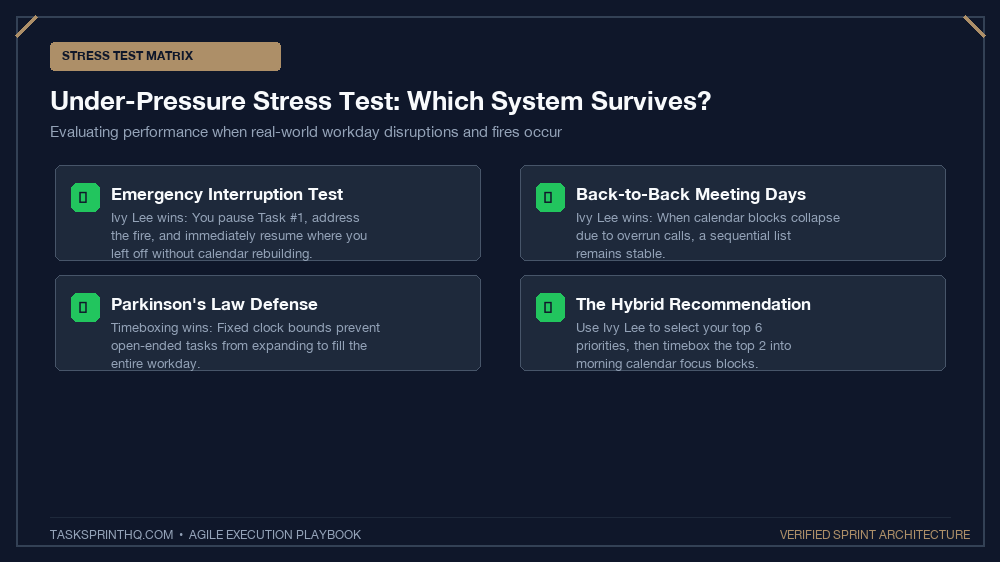
| Interruption Defense | Superior resilience. Resume Task #1 immediately after fire. | Vulnerable to domino delays across scheduled blocks. |
| Parkinson’s Law Defense | Weak; Task #1 can expand to fill the entire 8 hours. | Ironclad; hard clock boundaries force completion. |
The Hybrid Operating System: The 6-to-2 Priority Method
High-performing operators do not force an artificial either/or choice. Instead, they synthesize both methods into an airtight hybrid workflow:
- Evening Setup (Ivy Lee Protocol): Write down your 6 priority tasks for tomorrow. Rank them strictly 1 through 6.
- Morning Timeboxing (Cal Newport Protocol): Open your digital calendar. Schedule a 90-minute to 120-minute focus block exclusively for Task #1 between 9:00 AM and 11:00 AM. Schedule a secondary 60-minute block for Task #2 at 1:30 PM.
- Afternoon Flexible Queue: Leave your afternoon (2:30 PM to 5:00 PM) open for Tasks #3 through #6, administrative messages, and communications triage. For complementary prioritization tactics, see our guide on applying the 1-3-5 rule to daily task prioritization.
What to Do When Task #1 Refuses to Finish
The greatest vulnerability of the Ivy Lee method is perfectionism: you get stuck on Task #1, polish it obsessively, and reach 5:00 PM having touched zero secondary goals. To prevent this:
The 90-Minute Escalation Rule:
If you spend 90 consecutive minutes on Task #1 without tangible progress, pause immediately. Ask yourself: ‘Am I stuck due to missing information, or am I over-polishing?’ If missing info, demote it to your parking lot and advance immediately to Task #2.
Frequently Asked Questions
Is Ivy Lee better than timeboxing for students or writers?
Yes. Writers, researchers, and solo creators with minimal meeting schedules thrive under Ivy Lee because it preserves unbroken creative flow without arbitrary alarm clocks.
How long should a standard timebox last?
Cognitive research indicates that deep focus blocks between 60 and 90 minutes followed by a 15-minute detachment break offer the best compromise between depth and endurance.
What should I do if my #1 Ivy Lee task is completely blocked?
Under modern modifications, tag the blocked item as ‘Waiting On’, log the timestamp, and proceed immediately to task #2 without guilt.
Can I combine digital task managers with Ivy Lee?
While possible, physical paper or index cards provide superior psychological commitment and eliminate the urge to browse unrelated digital tabs.
Why does Ivy Lee limit tasks to exactly six?
Six tasks represents the upper boundary of meaningful daily cognitive capacity for complex knowledge work, preventing the paralysis caused by 20-item lists.