

Knowledge workers constantly seek the ideal operating framework to sustain laser-sharp concentration without suffering mental burnout. When planning daily sprint blocks, two dominant methodologies consistently emerge: the rigid, interval-based Pomodoro Technique and the calendar-anchored discipline of timeboxing.
Understanding the nuances of timeboxing vs pomodoro deep work performance allows you to match the right protocol to your specific cognitive demands. While both methods fight procrastination, they approach calendar architecture, flow states, and cognitive momentum from radically different psychological angles.
Understanding the Methodologies
To choose the right framework for your daily sprints, we must first examine the mechanics and underlying philosophy of each technique.

What Is the Pomodoro Technique?
Invented in the late 1980s by Francesco Cirillo, the Pomodoro Technique breaks complex tasks into strict 25-minute focus intervals separated by 5-minute restorative breaks. After completing four consecutive intervals (“Pomodoros”), you earn an extended 15-to-30-minute rest. The primary psychological mechanism is urgency: a ticking countdown forces your attention onto a singular task while keeping mental exhaustion at bay.
What Is Timeboxing?
Timeboxing takes a macro-level, calendar-driven approach. Instead of running generic 25-minute timers, you assign fixed calendar appointments to specific deliverables (for example, “Draft client technical proposal: 9:00 AM – 10:45 AM”). According to comprehensive research published in the Harvard Business Review, timeboxing ranks as the single most effective productivity technique because it forces you to convert abstract tasks into realistic chronological commitments.
Core Psychological Distinction:
Pomodoro manages energy through micro-breaks, while Timeboxing manages commitments through calendar boundaries. Pomodoro protects you from fatigue; timeboxing protects you from scope creep.
Direct Comparison: Timeboxing vs. Pomodoro
Examining how each system functions across critical workplace scenarios clarifies where each method excels:
| Dimension | The Pomodoro Technique | Calendar Timeboxing |
|---|---|---|
| Standard Focus Interval | 25 minutes (rigid cadence) | 60 to 120 minutes (flexible blocks) |
| Impact on Flow State | Can disrupt deep immersion with frequent alarms | Protects sustained immersion for complex problem solving |
| Calendar Alignment | Disconnected from external calendar schedules | Directly booked on Google Calendar or Outlook |
| Best Suited For | Repetitive admin, grading, editing, clearing backlogs | Software architecture, long-form writing, strategic design |
Why Pomodoro Can Sabotage Deep Work Sprints
While Pomodoro is brilliant for overcoming initial procrastination on dreaded tasks, experienced agile knowledge workers often find it disruptive during complex creative sprints. Cognitive science reveals that reaching genuine psychological “flow” requires between fifteen and twenty-three minutes of continuous immersion.
When your Pomodoro timer rings at the 25-minute mark just as your brain has assembled the multi-variable puzzle of a complex software algorithm or intricate client strategy, stopping for a 5-minute coffee break fractures your mental working memory. You are forced to reboot your cognitive environment from scratch upon returning.
If you prefer using digital countdowns without breaking immersion, pairing your workflow with modern software from our curated roundup of top focus timer apps with task integration gives you the flexibility to customize interval lengths up to 90 minutes.
When Timeboxing Dominates Agile Sprints
Timeboxing is the natural partner of the personal daily sprint framework. Because sprints are built around concrete daily deliverables, scheduling two 90-minute timeboxes directly onto your calendar creates unshakeable boundaries:
- Visual Territory Defense: Colleagues looking at your shared calendar see a solid 90-minute busy block, preventing them from scheduling frivolous check-in calls.
- Honest Sizing: You cannot book twenty timeboxes into an eight-hour day. Visual timeboxing instantly reveals whether your ambitions fit within reality.
- Parkinson’s Law Defense: Work expands to fill the time available for its completion. By assigning a strict 90-minute timebox to draft an article outline, you prevent the task from sprawling across the entire afternoon.
The Hybrid “Sprint Block” Framework
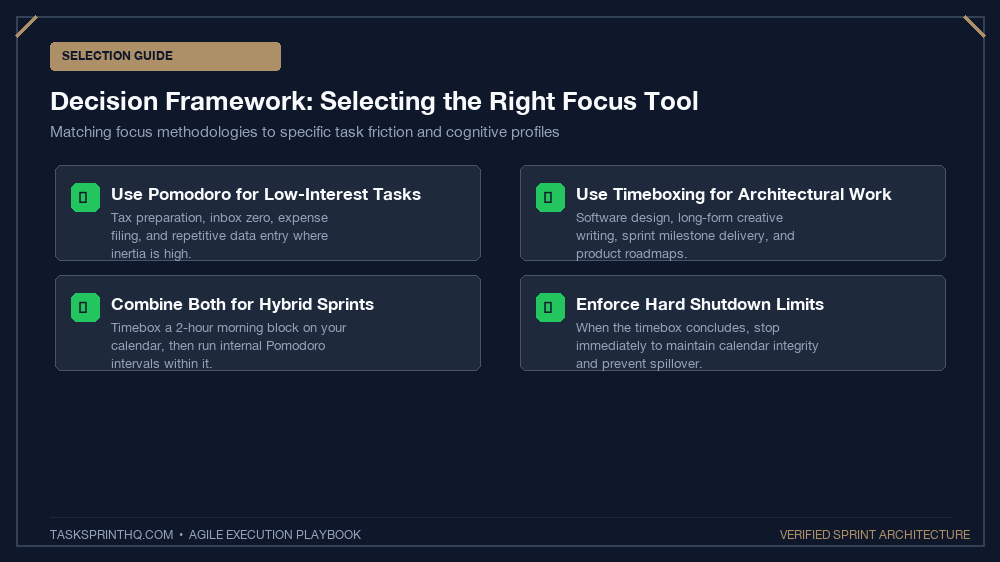
The most effective remote professionals do not treat these techniques as mutually exclusive rivals. Instead, they synthesize them into an elite hybrid system known as the 90/20 Sprint Block:
1. Morning Deep Work: 90-Minute Timeboxes
Dedicate your peak cognitive window (such as 9:00 AM to 10:30 AM) to a calendar timebox. Turn off all timers and alarms. Allow your brain to sink into uninterrupted, high-level flow to conquer your primary sprint deliverable.
2. Mid-Day Rest: 20-Minute Cognitive Decompression
Take an intentional break. Step away from computer monitors, take a brisk walk, drink water, and allow your brain to synthesize information without screen stimulation.
3. Afternoon Maintenance: 25-Minute Pomodoros
When afternoon fatigue arrives around 2:00 PM and executive focus wanes, switch gears. Fire up a classic 25-minute Pomodoro timer to power through administrative email replies, ticket grooming, and routine client communication without mental drag.
Sprint Block Golden Rule:
Use Timeboxing when the difficulty of the task is high and requires deep immersion. Use Pomodoro when the emotional resistance to starting the task is high and you need immediate momentum.
Common Mistakes to Avoid with Timeboxing and Pomodoro
Regardless of which method you select, avoid these three prevalent operational pitfalls:
- Back-to-Back Timeboxing: Scheduling four consecutive 90-minute timeboxes without calendar buffer creates cognitive burnout by 1:00 PM. Always schedule 15-minute buffers between blocks.
- Checking Social Feeds During Pomodoro Breaks: Scrolling Twitter, Instagram, or news sites during your 5-minute break does not rest your brain; it floods your working memory with high-stimulation noise. Use breaks for physical movement.
- Treating Timebox Limits as Failures: If your 90-minute timebox expires and your task is 85% complete, do not panic. Log the progress, assess why estimation drifted, and schedule a 30-minute polish block tomorrow.
Frequently Asked Questions
Can I adjust Pomodoro intervals to 50 minutes?
Yes. The “50/10” variant (fifty minutes of focused work followed by a ten-minute break) is widely popular among software engineers and designers because it allows deeper flow while maintaining the restorative discipline of scheduled rest.
What software is best for calendar timeboxing?
Google Calendar, Cron (Notion Calendar), and Fantastical provide seamless color-coding features. Color code your deep work sprint boxes in a distinctive accent color so your daily priorities stand out visually at a glance.
Select Your Focus Weapon Today
Neither Timeboxing nor Pomodoro is universally superior; each is an instrument calibrated for specific cognitive work. Deploy Timeboxing to build the foundational architecture of your daily sprints, leverage Pomodoro to demolish afternoon administrative clutter, and experience the extraordinary power of structured, disciplined daily focus.