

Virtually every professional has experienced the demoralizing reality of the bottomless to-do list. You open your notes app or task manager every morning to find forty-seven bullet points waiting for you. You cross off five tasks, write down four new ones, and end your workday feeling buried under an ever-expanding backlog that never offers closure.
Making the leap to transition to-do list to task sprint workflows breaks this psychological cycle. By shifting from an open-ended holding pen to structured 5-day agile sprints, you trade chronic task overwhelm for predictable focus, clear project completion, and restful weekends.
The Cognitive Flaws of Traditional To-Do Lists
To-do lists feel productive because adding an item provides an immediate dopamine hit of organization. In reality, unconstrained lists actively sabotage knowledge work productivity due to three fundamental design flaws:
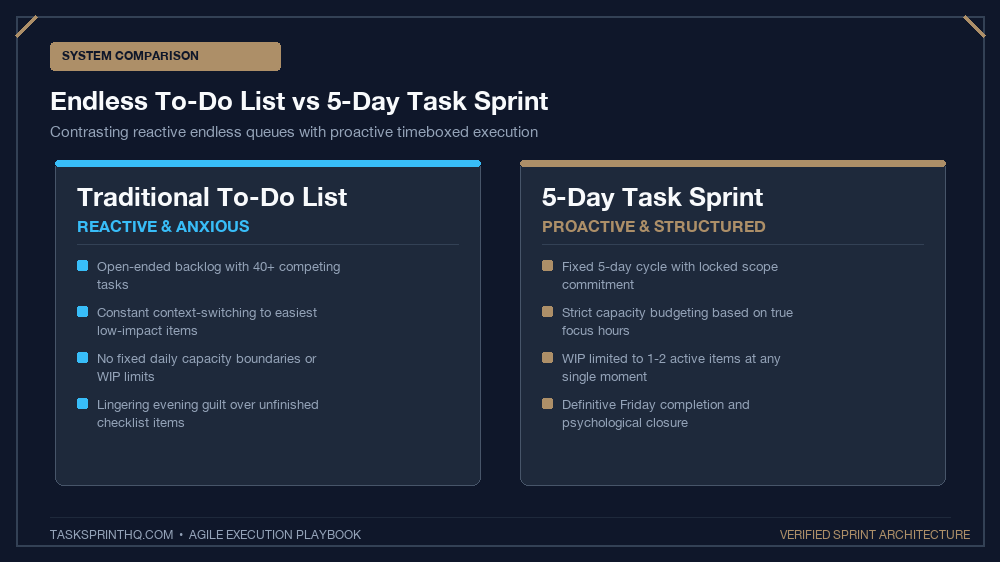
- The Zeigarnik Effect: The human brain fixates on incomplete tasks. Carrying fifty open to-do items creates subconscious cognitive strain that drains mental focus throughout the day.
- Lack of Temporal Constraint: A task list ignores time. It presents a five-minute errand (buy printer paper) directly alongside a forty-hour project (draft annual marketing plan) without indicating how or when they will fit into your calendar.
- Perpetual Moral Defeat: Because a to-do list is never empty, you can never declare victory. Even your most productive days feel incomplete.
Modern agile sprint frameworks, as detailed by productivity leaders at Asana, solve this by introducing fixed timeboxes and strict boundaries. When a sprint ends, you celebrate completed work and intentionally reset your board.
The 5-Day Sprint Mindset:
You cannot do everything this week—and you must stop pretending you can. Choose five meaningful deliverables, lock the door against new tasks, and execute with absolute focus.
The 4-Step Migration Blueprint
Transitioning from an open-ended to-do list to a disciplined 5-day sprint cycle requires a deliberate four-step shift in how you capture, prioritize, and execute work:
Step 1: The Great Backlog Triage
Take your existing 50+ item to-do list and conduct an honest triage session. Sort every task into one of three buckets:
- The Icebox (Someday/Maybe): Creative ideas and non-urgent desires. Move these to a separate, archived document out of daily sight.
- The Quick Hit Queue: Tasks requiring less than 5 minutes. Spend 60 minutes knocking out as many as possible today, or eliminate them entirely.
- Active Candidate Backlog: Legitimate projects that directly impact your revenue, health, or core professional goals.
Step 2: Define Your Weekly Sprint Theme
Every Sunday afternoon or Monday morning, establish a unifying theme for your upcoming 5-day cycle. Are you executing an “Onboarding Overhaul Sprint”, a “Sales Pipeline Sprint”, or a “Technical Debt Cleanup Sprint”? Having a central theme provides an instant filter when deciding which backlog items deserve admission.
Step 3: Select and Lock Your 5 Core Deliverables
Commit to exactly five core deliverables for the week—one primary objective per workday. If you need a structured method to rank these items, review our deep breakdown on the 1-3-5 rule for daily task prioritization to balance major breakthroughs with essential operational tasks.
Step 4: Establish the Daily Scope Gate
This is where most beginners struggle: when someone asks you to handle a new project on Tuesday afternoon, do not add it to your active week. Put it into next week’s candidate backlog. If an item is not an existential emergency, it waits for next Monday’s sprint planning session.
To-Do List vs. 5-Day Task Sprint: The Structural Shift
Comparing the mechanics of open lists versus structured sprints highlights the immediate relief this operational shift provides:
| Workflow Aspect | Endless To-Do List | 5-Day Task Sprint |
|---|---|---|
| Time Horizon | Infinite; continuous rolling queue | Fixed 5-day boundary (Monday to Friday) |
| Capacity Awareness | Zero; assumes infinite human endurance | High; restricted to realistic weekly capacity |
| Reaction to New Requests | Added instantly, causing reactive firefighting | Routed to triage backlog for future planning |
| Friday Psychological State | Anxiety over unfinished list items | Genuine celebration of locked weekly shipments |
The Ideas Parking Lot: Capture Without Distraction
When professionals abandon their 50-item to-do lists, they often experience an uneasy sensation: “What if I forget a brilliant creative idea while I am sprinting?” This anxiety is completely natural. The solution is creating a dedicated “Ideas Parking Lot”—a zero-friction holding space.
Whenever a spontaneous insight strikes you mid-sprint, jot it down in your parking lot note and immediately return your attention to your active deliverable. During Friday’s sprint review or Monday’s planning session, review your parking lot items calmly. In most cases, you will discover that ideas which felt urgent on Tuesday were merely fleeting distractions, saving you hours of wasted effort.
Overcoming the “What If It’s Urgent?” Fear
The primary objection to adopting weekly sprints is the fear of ignoring urgent opportunities. But when you analyze unplanned tasks, 90% of what feels “urgent” is merely noisy. To separate genuine crises from harmless noise, combine your sprint with our comparison of Eat That Frog vs Eisenhower Matrix for practical workflows.
By enforcing a 5-day sprint cycle, you train colleagues and clients that you are a focused professional who executes with precision, rather than a frantic reactive assistant available on demand.
Case Study: Sashing Overwhelm in 14 Days
Consider the experience of an independent digital consultant who was chronically overwhelmed by an active to-do list spanning seventy-eight open items. By shifting to a 5-day task sprint framework, the consultant archived seventy-two speculative tasks, locked in five core deliverables for the upcoming week, and established a daily 90-minute deep work block.
Within two weeks, the results were unmistakable: billable project throughput increased by 35%, client delivery deadlines were met three days ahead of schedule, and the chronic evening anxiety of facing an infinite list was completely replaced by calm, predictable focus.
Your 5-Day Sprint Kickoff Plan
Ready to escape the to-do list trap? Here is your exact sequence for next Monday morning:
- Archive your sprawling to-do list into a designated ‘Ideas Parking Lot’.
- Select five high-leverage deliverables that directly move the needle on your revenue or primary project goals.
- Assign exactly one core deliverable to each day from Monday to Friday.
- Protect your morning focus block and refuse all mid-day scope additions.
Reclaim Your Workweek
You do not need to spend your career trapped on a hamster wheel of infinite to-do lists. Close your sprawling task manager today, isolate five high-value commitments for next week, and embrace the clarity, focus, and peace of mind that only 5-day task sprints can deliver.
