

In agile software engineering teams, story point estimation is performed using group rituals like Planning Poker, where developers vote simultaneously to eliminate cognitive bias. When you operate as an independent freelancer, creator, or solo founder, applying team estimation rituals makes no sense. Yet attempting to plan your week using raw hourly estimates is equally disastrous because human beings consistently suffer from planning fallacy.
Adopting solo story point estimation allows you to size tasks based on cognitive complexity, uncertainty, and friction rather than optimistic clock time. Once you calibrate your personal baseline, you can forecast exactly how much work you can complete in a 5-day cycle without working late into the evening.
Why Hourly Estimation Fails Solo Knowledge Workers
According to agile sizing frameworks maintained by Scrum.org, story points represent an abstract blend of three distinct variables: effort volume, technical complexity, and risk/uncertainty.
When you tell yourself, ‘Writing this technical proposal will take three hours,’ you are measuring best-case clock time under frictionless laboratory conditions. But in reality, unexpected research rabbit holes, client revisions, and cognitive fatigue disrupt the schedule. Sizing the proposal as a 5-point task acknowledges that while the mechanical typing takes two hours, the mental energy and uncertainty require significant cognitive bandwidth.
The Solo Modified Fibonacci Scale
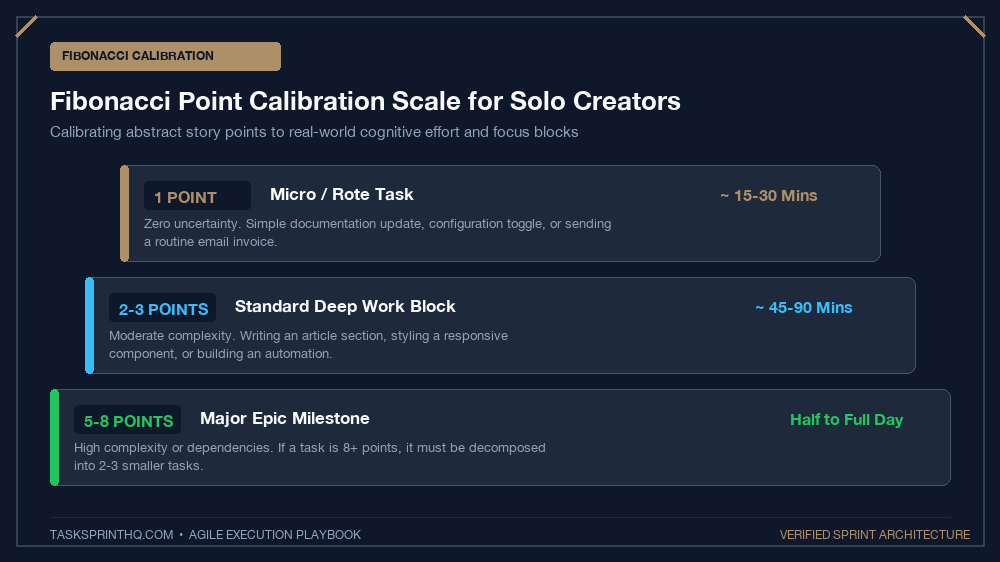
To keep estimation fast and avoid hair-splitting between 3.5 and 4 hours, use a modified Fibonacci progression (1, 2, 3, 5, 8). Each number represents an exponential step in complexity:
| Points | Task Character & Complexity | Typical Solo Example | Daily Allowance |
|---|---|---|---|
| 1 Point | Zero uncertainty; administrative or routine execution. | Invoicing clients, sending weekly recap email. | 3–4 tasks |
| 2 Points | Straightforward task with known steps, minimal friction. | Formatting a draft article, updating CSS styles. | 2–3 tasks |
| 3 Points | Standard core deliverable requiring focused deep work. | Authoring a 1,500-word blog post, designing a UI page. | 1–2 tasks |
| 5 Points | High complexity or unfamiliar technology; moderate uncertainty. | Integrating a new payment gateway, drafting contract spec. | 1 task (full day core) |
| 8 Points | Too large for a single sprint cycle; high risk of derailment. | ‘Build brand new course’ or ‘Redesign full website’. | Must be broken down |
The 8-Point Decomposition Rule:
If an item on your solo backlog receives an 8-point estimate, you are forbidden from scheduling it into an active sprint. An 8-point task is not a task—it is a project. Break it down into two 3-point deliverables and one 2-point deliverable before locking your weekly plan.
The 3-Step Solo Calibration Protocol
Step 1: Define Your Reference Benchmark
To anchor your scoring scale, identify a recurring task that you execute regularly with consistent effort. For most creators, drafting a standard technical article or client deliverable represents a reliable 3-point baseline. Every other item on your backlog is scored in relative comparison to this anchor.
Step 2: Calculate Your Sustainable Weekly Velocity
During your first two weeks of solo tracking, do not artificially inflate your target. Track what you actually finish. Most full-time solo professionals discover that their sustainable weekly velocity falls between 15 and 22 story points per 5-day cycle. Sizing beyond 25 points invariably triggers burnout or unfinished spillover. To fine-tune your personal limit, consult our formulas on calculating daily sprint capacity.
Step 3: Combine Sizing with Priority Rules
Once your tasks carry point values, pair them with structured daily execution frameworks. A proven approach is using our 1-3-5 rule for daily task prioritization, which translates naturally into: one 3-point task, three 1-point tasks, and five quick administrative checklist items.
Why Solo Creators Fail with Hours-Based Estimation
When freelancers and solo operators attempt to estimate projects in chronological hours, they fall victim to the Planning Fallacy—a well-documented cognitive bias identified by psychologists Daniel Kahneman and Amos Tversky. Humans consistently imagine the best-case execution scenario, systematically ignoring cognitive fatigue, software bugs, email interruptions, and administrative friction.
According to research highlighted by the Scrum Alliance, relative sizing using abstract story points decouples effort from the clock. Sizing tasks relatively allows you to group similar workloads together based on intuitive complexity rather than predicting exact clock minutes.
Detailed Solo Fibonacci Calibration Standards
To calibrate your solo estimation scale, use these concrete reference benchmarks across your project management board:
| Points | Complexity Level | Real-World Example | Typical Duration |
|---|---|---|---|
| 1 Point | Trivial / Mechanical | Update DNS records; fix typo in terms page; send monthly invoice. | 15 – 30 Minutes |
| 2 Points | Low Complexity | Write 1 section of newsletter; style a simple button component; configure Zapier hook. | 45 – 60 Minutes |
| 3 Points | Moderate Deep Work | Draft comprehensive blog article; build responsive navigation bar with dropdowns. | 90 – 120 Minutes |
| 5 Points | High Complexity | Complete Stripe customer portal integration; design 3-page Figma UI wireframe. | Half Workday (3-4h) |
| 8 Points | Full Epic (Decompose) | Build entire user authentication system from scratch. Must be split into 2-3 tasks. | Full Day (Warning) |
How to Calculate Your Solo Velocity Baseline
Velocity is the total number of story points you can comfortably ship in a standard 5-day or 7-day sprint cycle without working overtime. To calculate your baseline:
- Commit to a conservative number of points for your first sprint (e.g., 15 to 18 points for a solo creator).
- At the end of Friday, count only the points for tasks that are 100% completed according to your Definition of Done. If an 8-point task is 90% done, award 0 points for this sprint.
- Repeat this for three consecutive sprints and average the total:
(Sprint 1 + Sprint 2 + Sprint 3) / 3. - Use this exact rolling average as your hard ceiling when planning future cycles. If your average is 16 points, never admit 22 points into next week’s queue. For milestone breakdown strategies, check our blueprint on setting micro-milestones in a 1-week sprint.
The ‘Spike Task’ Strategy for Unknown Technical Work
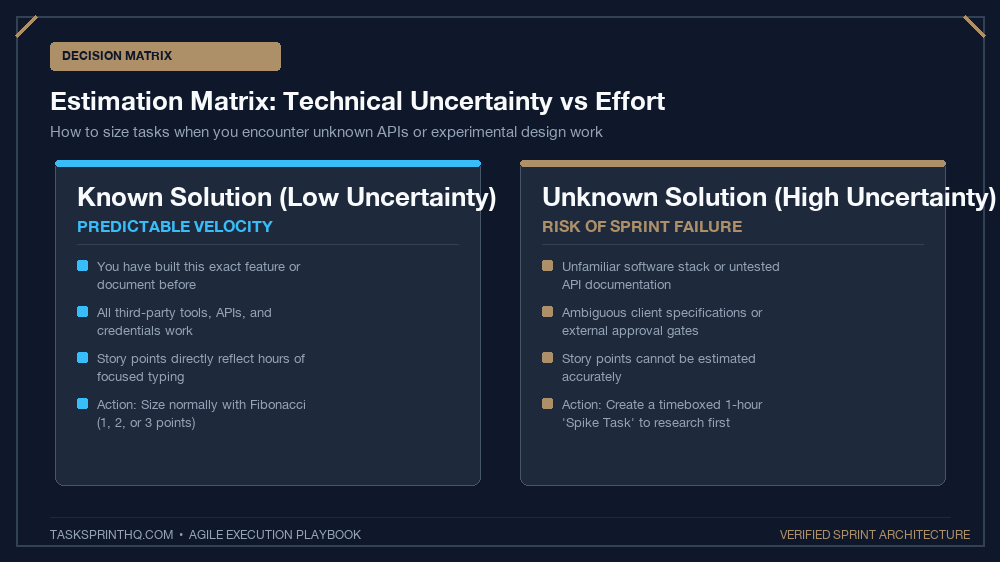
What should you do when a client or project requires using an unfamiliar library, framework, or API where you have zero intuition about complexity? Never assign a random 5 or 8 points.
Instead, create a timeboxed Spike Task sized at exactly 1 or 2 points (60 to 90 minutes). The sole objective of the Spike is to read documentation, test a quick prototype script, and identify hidden roadblocks. Once the spike concludes, you will have the operational clarity required to estimate the actual implementation tickets accurately.
Frequently Asked Questions
How do story points differ from estimated hours for solo workers?
Hours measure optimistic clock time under ideal conditions, while story points account for cognitive difficulty, technical risk, and the mental effort required to execute the work.
What should I do if a 3-point task takes twice as long as expected?
Never change the point value mid-sprint. Log the variance in your Friday retrospective. Over time, your calibration will improve, and similar tasks will naturally be estimated as 5 points in future cycles.
Can I assign fractional points like 1.5 or 2.5?
No. Fractional points reintroduce analysis paralysis. Stick strictly to the integer sequence: 1, 2, 3, 5, and 8.
Does tracking story points add unnecessary administrative overhead?
Sizing tasks takes less than 3 seconds per item during Monday planning. The 5 minutes invested on Monday saves hours of mid-week schedule panic.
What is the maximum number of story points recommended for a single day?
A solo knowledge worker should target between 3 and 5 total story points per day for optimal cognitive focus and sustainable long-term output.