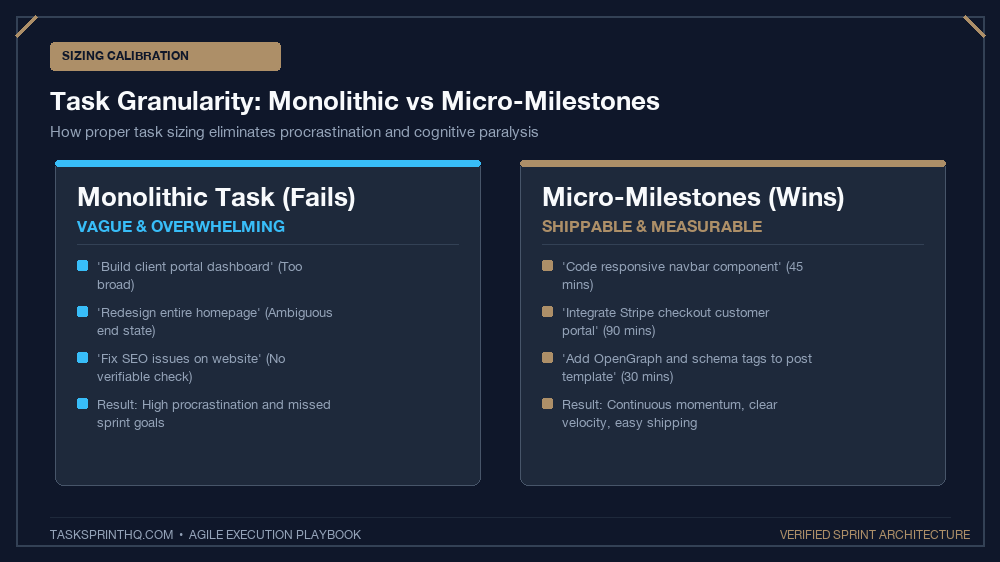
One-week sprints are among the most powerful agile rhythms for agile teams, solopreneurs, and fast-moving agencies. However, they carry a hidden vulnerability: five days pass with astonishing speed. If a team defines a single broad goal on Monday morning—such as “Ship redesign for client portal”—Friday afternoon arrives with the project only 70% complete and testing completely unaddressed.
The solution is mastering how to set micro milestones 1 week sprint cycles demand. By decomposing a five-day sprint into daily, non-negotiable proof points, you detect blockers within twenty-four hours, maintain constant operational momentum, and guarantee on-time delivery.
What Is a Sprint Micro-Milestone?
In standard project management, a milestone marks a major achievement, such as beta release or product launch. As outlined in project frameworks by Atlassian, milestones serve as critical progress checkpoints that validate direction without prescribing every minor task.
A micro-milestone scales this principle down to a single 24-hour increment within a 1-week sprint. It is not an individual to-do item (like “format CSS” or “reply to client email”). Instead, a micro-milestone represents a functional, testable stage of the deliverable that proves progress is real.
The 24-Hour Proof Rule:
Each day of a 1-week sprint must conclude with a verifiable artifact. If you cannot point to a visible demo, passing test suite, or finalized document by 5:00 PM, today’s micro-milestone was missed.
The 5-Day Micro-Milestone Blueprint
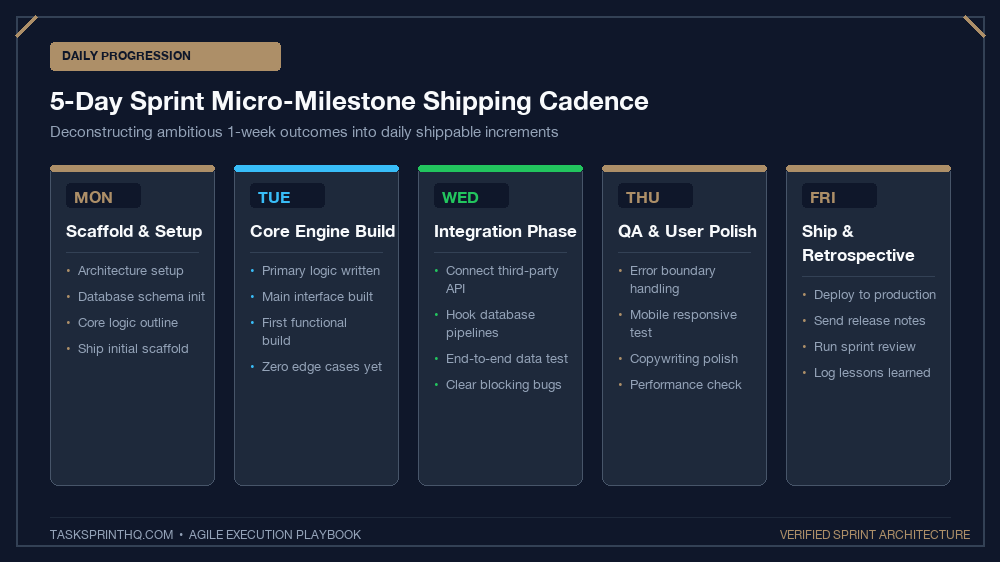
To structure a 1-week sprint for dependable execution, map out your five days using this balanced milestone progression:
Monday: Architecture, Scope Lock & Asset Staging
Never write final production code or high-fidelity design on Monday morning. Dedicate day one to structural foundations:
- Lock sprint scope and agree on technical boundaries.
- Stage external dependencies (copy assets, API documentation, brand vectors).
- Monday Micro-Milestone: A complete wireframe, system schema, or project outline reviewed and locked by 5:00 PM.
Tuesday: The Functional Engine (Core Mechanics)
Build the foundational engine of the feature. Ignore edge cases and visual styling; focus strictly on core mechanics:
- Implement primary database queries or draft raw content arguments.
- Construct functional layout scaffolding.
- Tuesday Micro-Milestone: A working “ugly prototype” that successfully processes data from start to finish.
Wednesday: Secondary Features & Integration
Connect your core mechanics to secondary modules and external services. This is the pivotal tipping point of the sprint:
- Integrate API endpoints, form validations, or content cross-references.
- Resolve edge-case logic.
- Wednesday Micro-Milestone: Feature functionality is 90% complete in a local staging environment.
If unexpected blockers or scope derailments appear on Wednesday, immediately apply our playbook on handling unplanned tasks mid-sprint without derailing goals to salvage your cycle.
Thursday: Polish, Cross-Device Testing & Quality Assurance
Stop writing new features on Thursday morning. Dedicate day four to rigorous hardening:
- Audit mobile responsive rendering, typography, and browser compatibility.
- Run automated unit tests and user flow sanity checks.
- Thursday Micro-Milestone: Feature frozen in release-candidate condition with zero critical bugs.
Friday: Production Deployment & Retrospective
Friday should never be a stressful scramble. Because you hardened on Thursday, Friday becomes a calm celebration:
- Deploy final build to production or send finished deliverables to client.
- Conduct your 15-minute retrospective.
- Friday Micro-Milestone: Project live, confirmed, and logged in sprint records by 2:00 PM.
1-Week Milestone Architecture: Real-World Example
Here is how a web design consultant maps out micro-milestones for a high-priority landing page sprint:
| Day | Sprint Focus | Verifiable Micro-Milestone | Verification Metric |
|---|---|---|---|
| Monday | Structure & Copy | Low-fidelity wireframe & approved headline copy | Figma frame link shared |
| Tuesday | Desktop Build | Full desktop HTML/CSS layout coded | Staging URL renders desktop layout |
| Wednesday | Form Integration | Stripe checkout & CRM webhook operational | Test transaction verified in CRM |
| Thursday | Mobile & Speed | Mobile responsive pass & 95+ PageSpeed score | Lighthouse audit report PDF |
| Friday | Launch & Handoff | Domain DNS pointed, client video walk-through recorded | Client sign-off confirmation email |
Handling Mid-Week Milestone Failure: The 24-Hour Recovery Protocol
What happens when Wednesday arrives and Tuesday’s prototype is still broken? In traditional teams, people panic and work late into the night. With micro-milestones, you execute the 24-hour recovery protocol:
- Isolate the Slippage: State clearly in writing what caused the gap: was an API endpoint undocumented, or was the design unexpectedly intricate?
- Descope Non-Core Polish: Immediately slash Thursday’s secondary animations or extra stylistic touches. The functional core must take priority over aesthetic flourishes.
- Preserve Friday’s Ship Date: Never push the sprint deadline into next week without reducing scope. Shipping an 80% feature on time beats shipping a 100% feature two weeks late every time.
How Micro-Milestones Eliminate Friday Panic
Dividing your sprint into daily checkpoints alters team psychology in three fundamental ways:
- Early Blocker Detection: If Tuesday’s milestone fails to ship, you know immediately that the project is slipping. You can course-correct on Wednesday morning rather than discovering failure on Friday afternoon.
- Sustained Dopamine Loops: Hitting a clear checkpoint every single day builds continuous psychological momentum, keeping morale high throughout the week.
- Seamless Integration with Solo Systems: Micro-milestones integrate naturally with our personal daily sprint framework, allowing solo operators to tackle massive projects with corporate-grade precision.
The ‘Almost Done’ Trap: Strict Completion Criteria
The greatest enemy of micro-milestones is the dangerous illusion of ‘almost done’. A developer might claim a feature is 95% complete on Tuesday afternoon, only to spend the next two days untangling obscure edge-case bugs. To maintain integrity, enforce strict binary completion criteria:
- A task is either 100% verified against its acceptance criteria, or it is officially incomplete. There is no partial credit.
- If code cannot be deployed to staging or reviewed by a peer, it cannot be marked done.
- Visual assets must be fully exported and organized in destination folders, not left as draft layers in Figma.
Why 1-Week Sprints Outperform 2-Week Sprints for Small Teams
Traditional corporate engineering departments favor two-week or three-week sprint cycles because large organizations have heavy deployment overhead. For small remote teams and agile agencies, however, two weeks is far too long. Fast-moving market conditions require rapid feedback loops. A 1-week sprint cycle provides fifty-two learning opportunities per year rather than twenty-six, dramatically accelerating team operational maturity.
Turn 5 Days into an Unstoppable Machine
One week is plenty of time to accomplish extraordinary work when every day has a clear purpose. Establish your daily proof points, honor the 24-hour verification rule, and watch your 1-week sprint cycles transform into a predictable, stress-free engine of high-impact delivery.