

Knowledge workers routinely begin their workdays facing an overwhelming mountain of responsibilities. You log into your project management app, glance at thirty-two competing tasks, and freeze. Faced with an impossible workload, our natural psychological default is to tackle the easiest, lowest-value errands first—leaving high-impact strategic deliverables perpetually unaddressed.
Implementing the 1-3-5 rule daily task prioritization framework provides an elegant, foolproof operating system to escape this trap. By forcing a strict mathematical limit on what you can commit to each day, you eliminate decision fatigue, guarantee meaningful progress on core objectives, and reclaim control over your calendar.
What Is the 1-3-5 Rule?
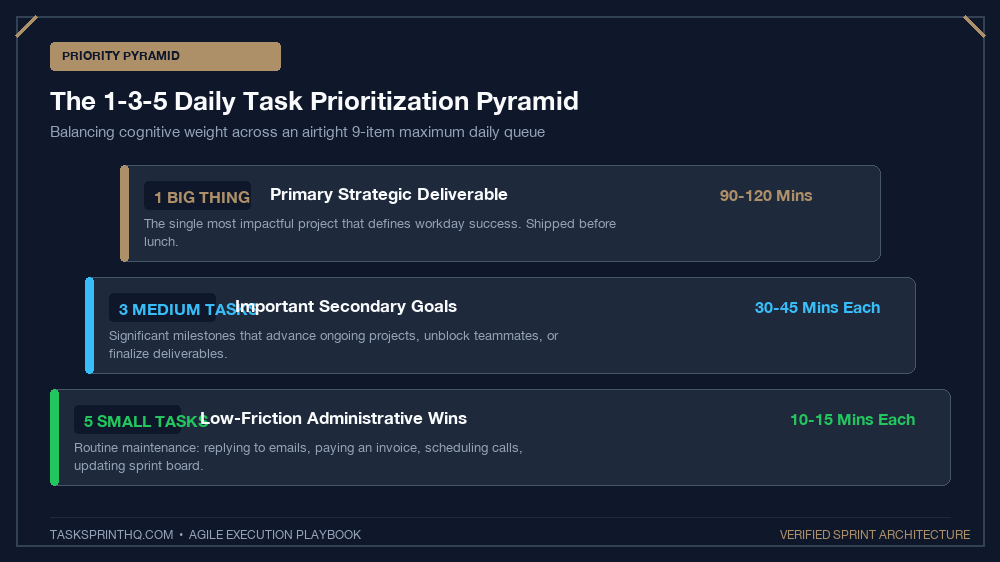
Originally popularized by career and leadership experts at Forbes and The Muse, the 1-3-5 Rule operates on a simple, non-negotiable premise: on any given working day, you cannot realistically accomplish an unlimited number of tasks. Instead, you commit to exactly nine items structured in a strict hierarchy:
- 1 Major Thing: The single highest-leverage deliverable that moves your core project forward.
- 3 Medium Things: Essential operational milestones, client requirements, or secondary deliverables.
- 5 Small Things: Low-friction administrative tasks, quick emails, file updates, or scheduling errands.
The 9-Task Rule:
You are permitted exactly 1 Major, 3 Medium, and 5 Small tasks per day. Once those nine slots are committed, your daily list is locked. Everything else must wait in your backlog for tomorrow’s selection cycle.
The Psychology Behind the 1-3-5 Hierarchy
Why does this specific 1-3-5 structure work so effectively when open-ended to-do lists routinely fail? The answer lies in cognitive load theory and behavioral psychology:
1. Forced Decision-Making (Eliminating the Illusion of Infinite Time)
When you have an unconstrained list of twenty items, you subconsciously pretend that all twenty can be completed. The 1-3-5 framework forces you to make tough trade-offs during morning planning rather than suffering disappointment at 5:00 PM. If you are working to transition from endless to-do lists to task sprints, the 1-3-5 framework is the ideal tactical bridge.
2. The Psychological Anchor of the ‘1 Major Thing’
By identifying your single major objective before opening your inbox, you establish a definitive definition of daily success. Even if unexpected crises disrupt your afternoon and derail two of your medium tasks, finishing your “1 Major Thing” guarantees that your day was an undeniable operational victory.
3. A Controlled Outlet for Low-Cognitive Chores
Productivity systems that demand eight hours of unbroken strategic brilliance ignore human nature. We all need simple, low-effort chores to complete when our brains are tired after lunch. The “5 Small Things” bucket gives you permission to clear administrative errands without feeling guilty about procrastinating.
How to Categorize Tasks Accurately
The most common beginner mistake is misclassifying task size. Use this calibrated sizing guide to sort your backlog accurately:
| Tier | Estimated Duration | Cognitive Intensity | Real-World Example |
|---|---|---|---|
| 1 Major Thing | 2.5 to 3.5 Hours | High (Deep creative or architectural focus) | Write client proposal RFP draft; refactor payment gateway module |
| 3 Medium Things | 45 to 60 Mins Each | Moderate (Focused execution with clear specs) | Conduct candidate screening interview; build newsletter campaign; review PR |
| 5 Small Things | 5 to 15 Mins Each | Low (Routine admin or communications) | Pay hosting invoice; send calendar invite; approve expense report; backup DB |
Step-by-Step Daily Implementation Protocol
To execute the 1-3-5 framework seamlessly within your existing routine, follow this four-step morning ceremony:
Step 1: The Morning Backlog Scan (5 Minutes)
Open your master project board or candidate backlog. Scan pending deadlines, client deliverables, and strategic commitments. Resist the urge to begin working on whatever card looks easiest.
Step 2: Commit Your ‘1 Major Thing’ First
Ask yourself: “If I could only finish one single deliverable today before being called away on an emergency, which one would deliver the greatest business impact?” Write this item at the top of your physical index card or digital workspace.
Step 3: Select Your 3 Medium Supporting Tasks
Choose three tasks that require meaningful concentration but have bounded scopes. Ensure these tasks unblock teammates or keep ongoing client contracts healthy.
Step 4: Fill Your 5 Small Administrative Slots
Pick five quick errands that have accumulated in your inbox. Batch these together for execution during your post-lunch afternoon lull. If you struggle with deciding between competing urgent demands, compare our analysis of Eat That Frog vs Eisenhower Matrix for practical workflows to sharpen your triage skills.
Sample 1-3-5 Daily Action Card
Here is what an authentic, highly effective daily 1-3-5 card looks like for an independent software product consultant:
Daily 1-3-5 Sprint Card — Tuesday
⭐ 1 MAJOR THING:
• Complete and export interactive prototype for Client Acorn onboarding redesign (Target: 9:00 AM – 11:45 AM)
🔷 3 MEDIUM THINGS:
1. Write technical documentation for authentication webhook integration (45 mins)
2. Audit staging server logs for latency anomalies during load test (45 mins)
3. Record 5-minute video walkthrough for frontend contracting team (30 mins)
🔹 5 SMALL THINGS:
1. Send finalized invoice #1042 to accounting
2. Reply to Sarah’s Slack query regarding API deprecation date
3. Update weekly sprint status in Notion board
4. Confirm Thursday client workshop calendar invite
5. Clean local desktop staging downloads folder
What to Do When the 1-3-5 List Collapses
Inevitably, unexpected production fires will disrupt your plans. A critical server crashes, or a VIP client requests an emergency call. When this occurs:
- Protect the Major Thing: If at all possible, protect your 1 Major Thing. Move two Medium items and three Small items to tomorrow to create space for the crisis.
- Downgrade Unfinished Items Without Guilt: If your Major Thing was completed but only one Medium item was touched, celebrate. You accomplished 80% of today’s true value. Roll remaining items into tomorrow’s candidate pool.
- Never Expand Beyond Nine: If someone asks you to handle an extra request mid-day, you must negotiate: “I can add this to today’s list, but which of my existing three Medium items should I drop to make room?” This enforces mutual respect for capacity.
Transform Your Focus with the 1-3-5 Rule
Prioritization is not about discovering more hours in the day; it is about bringing ruthless clarity to the hours you already have. Adopt the 1-3-5 rule daily task prioritization framework tomorrow morning, restrict your commitments to nine deliberate outcomes, and experience the quiet satisfaction of finishing what matters most.
