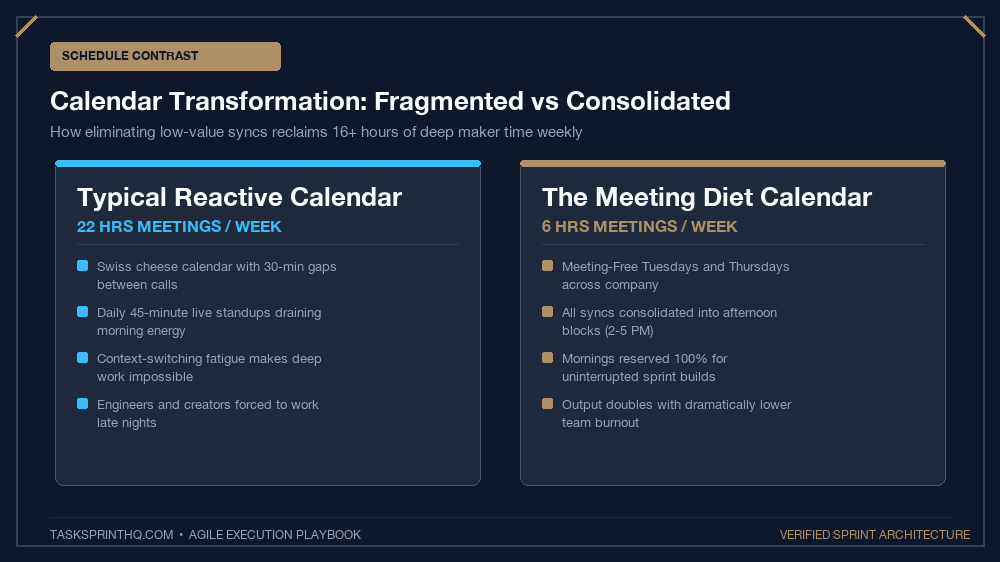
Look at your corporate calendar right now: a patchwork quilt of colored rectangles stretching from 9:00 AM to 5:00 PM. Standup calls, sync meetings, weekly alignment check-ins, brainstorms, and committee reviews leave knowledge workers with fragmented 15-minute gaps throughout the day. You spend your entire workday talking about work, and then log back on at 8:00 PM to complete the actual deliverables you were hired to build.
Implementing a rigorous framework to cut weekly team meetings 50 percent is the single fastest way to restore organizational sanity. By auditing low-value syncs, instituting strict meeting thresholds, and replacing verbal status roll calls with asynchronous written workflows, your company reclaims hundreds of hours of deep focus.
The Hidden Financial and Cognitive Drain of Meetings
Meetings feel productive because they create an immediate illusion of alignment and collective effort. In truth, unnecessary meetings are the most expensive operational waste in modern corporate life.
According to workplace studies published by the Harvard Business Review, when companies reduce meeting volume by just 47%, employee productivity increases by 71%, stress declines by 57%, and overall job satisfaction surges. Every time eight engineers sit in a 45-minute status meeting, the business is not investing 45 minutes—it is burning six full hours of expensive technical capacity.
The Synchronous Threshold Rule:
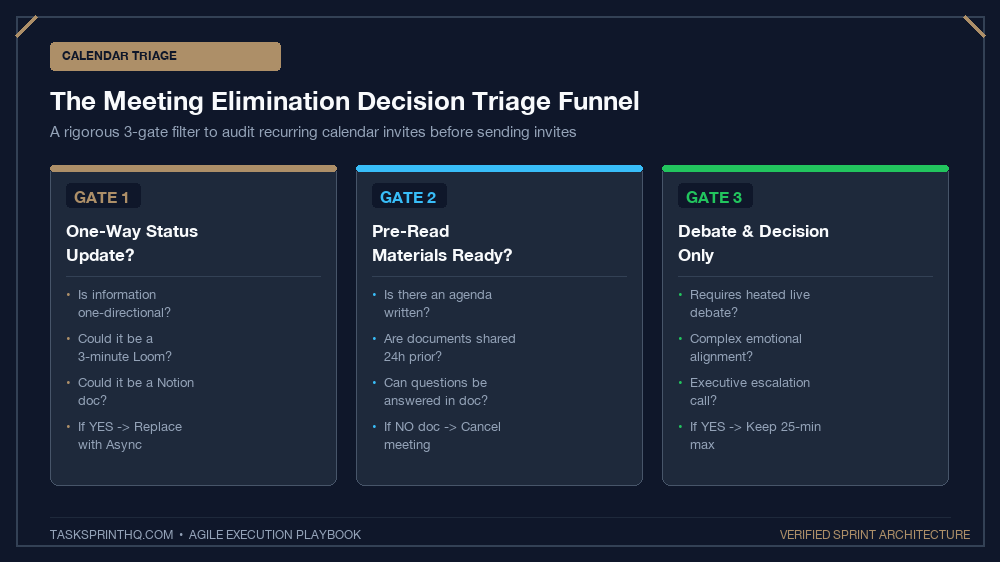
A meeting is justified ONLY if its primary goal is high-stakes debate, sensitive interpersonal feedback, or complex brainstorming. If the purpose of the meeting is merely information sharing, it must be an email, memo, or Slack thread.
The 4-Step Meeting Diet Protocol
To cut your team’s meeting load in half within fourteen days without causing operational blind spots, execute this four-step diet plan:
Step 1: The Calendar Audit (The Red-Pen Session)
Open your team’s recurring calendar appointments and audit every repeating event against this diagnostic rubric:
- The Status Roll Call: Does the meeting consist of participants going around the room reciting what they did? Action: Cancel immediately and replace with our daily standup Slack workflow.
- The “FYI” Presentation: Does one person present slides while ten others listen passively? Action: Record a 5-minute Loom video and share the deck in writing.
- The Zombie Meeting: Was this meeting created months ago to solve a crisis that has long since passed? Action: Delete recurring series.
Step 2: Institute “No-Meeting Focus Days”
Declare Tuesday and Thursday as company-wide or department-wide “No-Meeting Days”. On these days, scheduling internal video calls is strictly banned. Having two complete, unbroken 8-hour days of deep work allows engineers, writers, and analysts to achieve profound flow states and tackle complex creative challenges without interruption.
Step 3: Enforce the “No Agenda, No Attendance” Rule
Institute an inviolable organizational policy: if an organizer sends a calendar invitation without a written agenda, desired outcome, and prep materials attached at least 24 hours in advance, invitees have explicit permission to decline without penalty. This single rule forces organizers to think deeply before taking their colleagues’ time.
Step 4: Transition Retrospectives and Reviews to Async
Sprint reviews and retrospectives do not need to consume two hours on Friday afternoon. Convert them to written formats using our proven blueprint for a 15-minute async team retrospective to capture rich, thoughtful improvements in a fraction of the time.
Meeting Classification Framework: Sync vs. Async
Use this decision tree to determine whether a topic deserves a live calendar invite or a written document:
| Meeting Type | Default Format | Recommended Alternative Tool | Expected Time Savings |
|---|---|---|---|
| Daily Standup | Replace with Async | Slack Workflow Builder or Geekbot | 2.5 hours / week per person |
| Weekly Status Report | Replace with Async | Written Notion digest or Loom screen recording | 1.0 hour / week per person |
| Sprint Retrospective | Replace with Async | Threaded Slack / Notion retro board | 1.5 hours / week per person |
| Strategic Brainstorming | Keep Synchronous | Live FigJam / Miro workshop (Strict 45m cap) | Optimized focus output |
| Performance & 1-on-1s | Keep Synchronous | Live video check-in (Bi-weekly cadence) | High trust and morale retention |
How to Politely Decline Unnecessary Meetings
Individual contributors often feel powerless to escape meeting clutter. Use these polite, professional declining scripts to protect your calendar with grace:
Script 1: Proposing an Async Alternative
Script 2: Asking for an Agenda
What to Do with Your Reclaimed Hours
When you cut 50% of your meetings, your calendar suddenly opens up with expansive blocks of quiet white space. Do not fill this space with frantic busywork. Protect these reclaimed focus hours for your highest-leverage sprint goals, strategic thinking, and deep rest.
The 25-Minute and 50-Minute Calendar Default Rule
Standard enterprise calendar apps default to 30-minute and 60-minute blocks. This subtle default causes massive cognitive exhaustion because meetings run back-to-back with zero recovery time. Change your organization’s default calendar settings to 25 minutes (for half-hour calls) and 50 minutes (for hour-long calls).
Instituting this “Speedy Meetings” policy automatically injects 5 to 10 minutes of cognitive buffer between calls, allowing employees to take bio breaks, drink water, and clear mental cache before their next commitment.
Calculating the Real Dollar Cost of Meetings
To convince skeptical executives to embrace the meeting diet, calculate the cold financial reality: take the average hourly wage of attendees, multiply it by the number of participants, and multiply by meeting duration. An eight-person senior executive sync costs over ,200 per hour. When leadership realizes that a recurring weekly status call burns over ,000 annually, the enthusiasm for asynchronous alternatives skyrockets.
Start the Meeting Diet This Monday
Meeting addiction is an organizational habit, not an immutable law of physics. Audit your recurring calendar invites today, cancel the performative status check-ins, institute no-meeting focus days, and experience the extraordinary productivity and calm of a truly focused workweek.