Every morning across thousands of remote organizations, a familiar ritual plays out: eight to twelve distributed engineers, product designers, and project managers log into a Zoom call at 9:30 AM. For fifteen to thirty minutes, individuals take turns reciting a mechanical list of yesterday’s tasks while everyone else stares into the camera, mentally disengaged or secretly checking email.
Learning how to replace daily standup slack workflow systems liberate distributed teams from this calendar drain. By transforming verbal roll calls into structured, automated written check-ins, your organization preserves unbroken morning deep work, respects global timezones, and captures valuable operational data directly in your team’s central chat channels.
The Hidden Costs of Synchronous Daily Standups
The daily standup was originally designed by agile pioneers for small teams physically co-located in a single room. Standing up in a circle was intended to keep the gathering under ten minutes. However, when translated directly into remote video calls, standups suffer from severe organizational handicaps:

- The Context-Switching Tax: A 15-minute meeting at 9:30 AM fragments the entire morning. Research shows that knowledge workers require up to 23 minutes to regain deep focus after any meeting disruption.
- Timezone Inequity: A standup that occurs at 9:00 AM for headquarters in New York forces engineers in San Francisco to wake up early and teammates in Europe to interrupt their evening.
- Zero Persistent Memory: Verbal updates evaporate into thin air the moment the call ends. If a teammate is on leave or working different hours, they miss critical blocker updates.
According to best practices outlined by collaboration experts at Slack, asynchronous meetings solve these friction points by allowing contributors to share context when it suits their schedule while maintaining total transparency across the organization.
The Asynchronous Standup Rule:
Standups are for unblocking dependencies, not performing status theater for management. If an update does not require coordination, a written bullet point is always superior to a video call.
The 3-Question Slack Standup Template
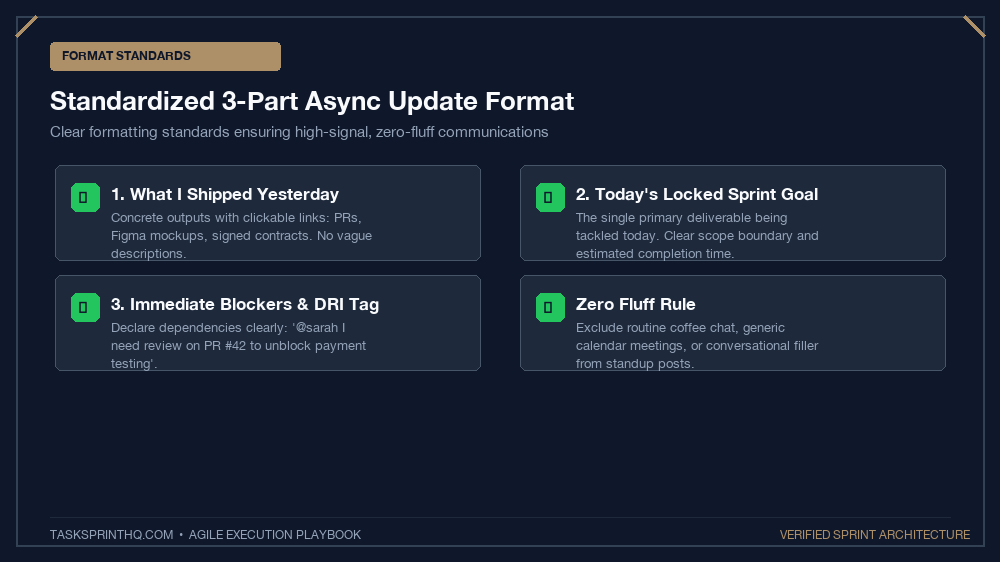
To keep written standups concise and actionable, discard the traditional vague questions (“What did you do yesterday?”). Replace them with this forward-looking, outcome-focused template:
2. Today’s Locked Focus: What primary ticket or user story are you committing to today?
3. Blockers & Dependencies: What specific external dependency is slowing you down, and who can unblock you? (Tag @username)
By forcing team members to specify @mentions on blockers, the standup immediately routes action items to the right colleague without wasting the entire team’s time. If you need to streamline handoffs across multiple continents, combine this with our async handoff checklist for distributed teams across timezones.
Live Zoom Standup vs. 5-Minute Slack Workflow
Comparing the operational reality of synchronous versus asynchronous standups illustrates why high-velocity engineering teams make the switch:
| Dimension | Traditional Zoom Standup | 5-Minute Slack Workflow |
|---|---|---|
| Time Consumed Per Person | 20 to 30 minutes of passive listening | 3 to 5 minutes of focused typing |
| Calendar Impact | Hard interruption puncturing peak morning focus | Zero interruption; completed during natural workday start |
| Searchability & Audit Trail | None; conversations vanish into thin air | 100% searchable in Slack channels and archives |
| Global Timezone Support | Penalizes non-headquarters timezones heavily | Completely timezone-agnostic across 24 hours |
How to Build the Automated Slack Workflow (Step-by-Step)
You do not need expensive third-party bot subscriptions to set up an async standup. Slack’s native Workflow Builder handles this in four simple steps:
Step 1: Create a Dedicated Standup Channel
Create a public channel named #standup-engineering or #daily-checkins. Keeping standup posts separate from conversational channels ensures updates are easy to scan and never buried under casual chatter.
Step 2: Trigger a Scheduled Morning Prompt
Open Slack Workflow Builder and configure a scheduled trigger. Set it to post a prompt every Monday through Friday at 9:00 AM local team time: “Good morning team! Please share your 3-point standup update in this thread before 10:30 AM.”
Step 3: Mandate Threaded Replies
Instruct all team members to post their daily updates as replies within the daily prompt thread, rather than posting in the main channel. Threading keeps the channel pristine, allowing anyone to review the entire team’s updates in a single tidy feed.
Step 4: Establish the Blocker Escalation Rule
If someone flags an active blocker in Question 3, the tagged teammate must acknowledge the thread with an emoji within two hours. If the issue requires complex live debugging, the two individuals schedule a private 1-on-1 huddle—sparing the rest of the team from sitting through unrelated technical debates. If your leadership is looking for a comprehensive roadmap to eliminate calendar clutter, explore our proven meeting diet plan to cut weekly team meetings by 50%.
Handling Accountability in Async Check-Ins
A frequent management concern is: “How do I know people are actually working if we don’t meet on video?” The reality is that verbal presence on a video call proves attendance, not productivity. A written update forces individuals to commit to concrete deliverables in public:
- If someone writes “Still working on user authentication” for three consecutive days with zero details, managers spot the stagnation immediately.
- Team members gain total autonomy over their daily schedules, leading to higher job satisfaction and lower turnover.
- Documentation culture improves across the entire engineering department as clear writing becomes the standard mode of operation.
The 14-Day Async Trial Protocol
To introduce this change without triggering organizational resistance, propose a two-week pilot to your leadership. Agree to pause live morning standups for fourteen consecutive days, run the Slack workflow, and survey the team at the end of the trial. In virtually every case, teams report higher energy, fewer interruptions, and zero decline in alignment.
Automating Summaries and Standup Digests
Once your team gets into the rhythm of posting threaded standup updates, you can use Slackbot or Zapier integrations to automatically aggregate all daily updates into a searchable weekly digest in Notion or Coda. This gives engineering directors and executives high-level visibility without requiring them to monitor live channels throughout the day.
Handling True Emergencies Outside Standup Channels
An asynchronous standup workflow is designed for routine sprint coordination. If an authentic, high-severity production outage occurs (such as a database downtime or security intrusion), team members should never wait for the scheduled morning standup prompt. Severe incidents bypass the standup workflow entirely and trigger automated PagerDuty or OpsGenie alerts into a designated incident response war room.
Reclaim Your Morning Focus
Morning hours are the most precious cognitive real estate in knowledge work. Stop squandering them on twenty-minute verbal roll calls. Deploy this 5-minute Slack workflow tomorrow, restore hours of deep engineering focus, and empower your distributed team to execute with clarity and freedom.