In modern product organizations, virtually no feature exists in isolation. A frontend engineer cannot finalize a billing screen until a backend engineer deploys the subscription API; the marketing team cannot launch a product campaign until the design team delivers finalized video assets. In remote environments where teams work asynchronously across continents, unmanaged dependencies are the single greatest cause of missed deadlines.
Mastering how to manage project dependencies remote teams face prevents these paralyzing logjams. By replacing informal chat assumptions with visual dependency mapping, explicit service-level agreements, and decoupled sprint architectures, cross-functional teams execute with harmony and speed.
The Remote Dependency Trap
When teams share a physical office, managing dependencies is relatively simple: an engineer walks across the hall to tap a colleague on the shoulder and ask when an API endpoint will be ready. In distributed, asynchronous organizations, that informal crutch disappears completely.
According to project governance research published by the Project Management Institute (PMI), cross-team dependencies cause up to 70% of delivery delays in complex initiatives. Without centralized visualization, teams make silent assumptions about each other’s release schedules, resulting in stalled sprints and finger-pointing when deadlines slip.
The Decoupling Imperative:
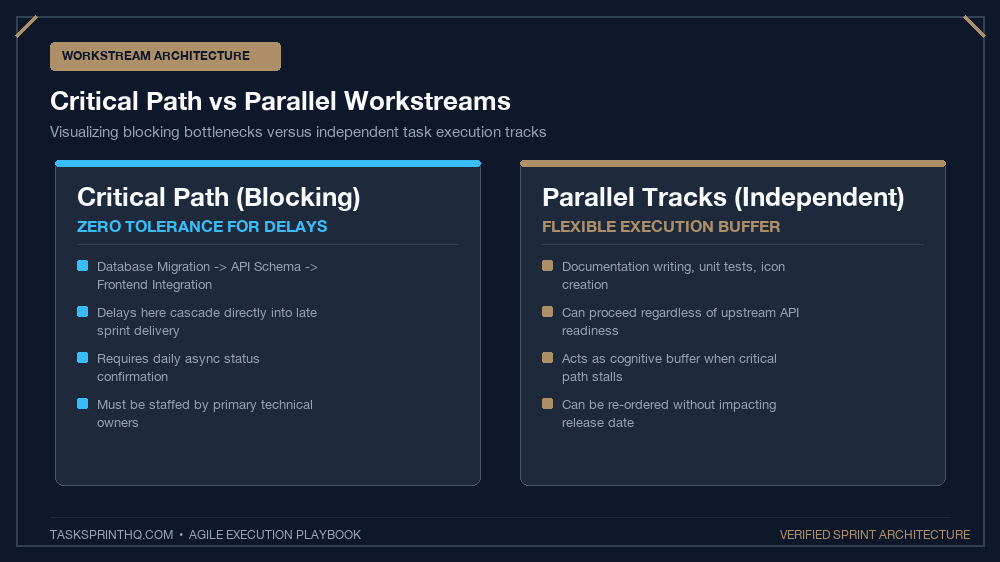
The best way to manage a dependency is to eliminate it. Whenever possible, design technical architectures and team scopes so contributors can build against mock contracts without waiting for live deliverables.
The 4 Types of Cross-Functional Dependencies
Before you can coordinate dependencies effectively, you must diagnose which variety of constraint you are navigating:
| Dependency Type | Operational Nature | Real-World Example | Mitigation Strategy |
|---|---|---|---|
| Technical (Sequential) | Task B cannot physically start until Task A finishes | Frontend checkout UI requires backend Stripe webhook endpoint | Define JSON API contract schemas and build with mock endpoints |
| Resource (Expertise) | Multiple teams compete for the same specialized human resource | Three product squads all require the sole DevOps engineer for deployment | Create self-serve CI/CD deployment templates and documentation |
| External (Vendor/Client) | Delivery depends on third-party approval or API certification | Mobile app release pending Apple App Store review guidelines | Buffer 7-day lead time into roadmap; ship behind feature flags |
| Knowledge (Context) | Work blocked awaiting stakeholder clarification or copy approval | Design team waiting for legal department to approve GDPR terms | Enforce strict “Definition of Ready” before ticket admission |
The 4-Step Remote Dependency Management Framework
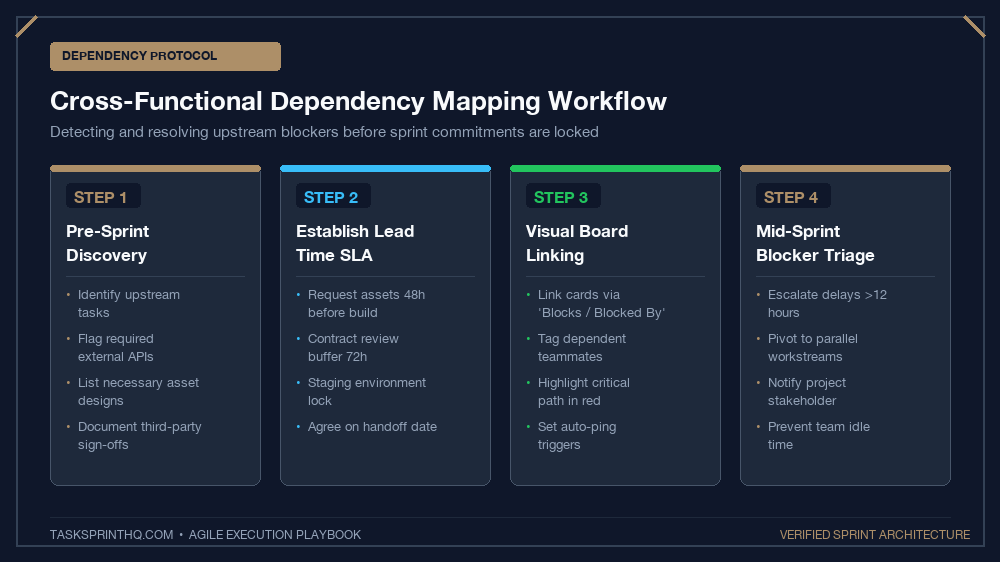
To eliminate cross-team bottlenecks across distributed sprint cycles, implement this four-step operating protocol:
Step 1: Visual Dependency Mapping (Before Sprint Lock)
Never commit to cross-functional deliverables without visual dependency tracking. Modern project platforms allow you to create explicit “Blocked By” and “Blocks” parent-child relationships. If your organization relies on Asana, review our in-depth tactical guide on preventing workflow bottlenecks with Asana task dependencies.
Step 2: Establish the Interface Contract (The Mock Protocol)
In technical engineering, frontend and backend teams should never work in a strict waterfall sequence. On Monday morning of sprint planning, both teams spend sixty minutes locking a standardized API contract schema (in Swagger/OpenAPI or JSON format). Once the schema is agreed upon, the frontend team builds against local mock data while the backend team builds live database queries in parallel. When Friday arrives, integration takes thirty minutes instead of five days.
Step 3: Stagger Sprints Across Dependent Squads
Attempting to run dependent tasks within the exact same 1-week sprint cycle is an invitation to disaster. If the backend team finishes their task on Thursday afternoon, the frontend team has less than twenty-four hours to build, test, and ship. Instead, introduce a one-sprint offset: the backend builds the foundation in Sprint 1; the frontend integrates it seamlessly in Sprint 2. Coordinate this offset during your asynchronous sprint planning for remote teams.
Step 4: Centralized Dependency Radar Dashboard
Create a centralized dashboard that highlights all cross-team blockers in a single view. Product leads review this radar twice per week. If a dependency card turns red (indicating the upstream deliverable is delayed), downstream teams receive automated notifications immediately, allowing them to adjust their sprint goals days before deadlines are breached.
Establishing Cross-Team “Service Level Agreements” (SLAs)
Informal goodwill is not an operating strategy. Establish clear, written SLAs between departments:
- Design to Engineering: Final Figma mocks and copy must be delivered and approved at least 48 hours prior to sprint planning kickoff.
- Code Review SLAs: Pull requests blocking another squad must receive an initial review within four working hours.
- DevOps Infrastructure Requests: Staging database provisioning requests require a minimum 3-day advance notice ticket.
Overcoming the ‘Not My Problem’ Remote Silo
In distributed environments, teams can easily become insular tribes focused exclusively on their own internal sprint boards. Foster cross-functional ownership by holding project leads accountable for the end-to-end user outcome, not merely their departmental sub-task. When shared success is rewarded, cross-team handoffs become proactive and collaborative.
The Dependency Risk Scoring Matrix
To prioritize dependency tracking, score each cross-team handoff using a simple 1-to-5 Risk Index based on two variables:
- Probability of Delay (1 to 5): How technically experimental is the upstream deliverable? How busy is the dependency team?
- Severity of Downstream Impact (1 to 5): If this handoff is delayed, does it stall one engineer for two hours, or does it freeze an entire department’s product launch?
Multiply Probability by Impact. Any dependency scoring 15 or higher is classified as a “High-Risk Anchor”. High-risk anchors require dedicated weekly syncs between tech leads to verify progress days before the sprint handoff occurs.
Handling 3rd-Party Vendor Dependencies
External dependencies—such as waiting for payment provider verification, third-party API keys, or compliance audits—are inherently unpredictable. Never place an external vendor dependency on your critical sprint path. Always construct local mock services or feature toggles so your engineering sprints remain fully decoupled from external corporate delays.
Automated Webhook Alerts for Critical Path Blockers
Modern issue tracking platforms like Linear, Jira, and GitHub allow teams to configure automated webhook alerts into team Slack channels whenever a parent ticket’s status changes. When an upstream backend API ticket is marked ‘Merged to Staging’, the downstream frontend team receives an instant automated notification. This eliminates the need for manual check-in pings and ensures downstream developers can pull the live code the very moment it becomes accessible.
Build Dependencies Out of Your Workflow
Unmanaged dependencies are the silent poison of remote productivity. Map your critical paths visually, build against decoupled mock interfaces, stagger sprint commitments responsibly, and watch your cross-functional organization ship complex projects with clockwork precision.