You sit at your clean desk, open your workspace laptop, and stare blankly at your monitor. You know exactly what task needs to be completed—a comprehensive client strategy document, a massive code refactor, or a high-stakes proposal. Yet an overwhelming wave of mental resistance freezes your hands. Thirty minutes slip away in aimless browser tab shuffling and quiet self-criticism.
This agonizing state is known as task paralysis. Overcoming task paralysis 2 minute kickstart strategies provide a scientifically grounded escape hatch. By lowering activation energy to an almost laughable threshold, you bypass the brain’s threat-detection mechanisms and initiate effortless, sustained momentum.
The Neuroscience of Task Paralysis
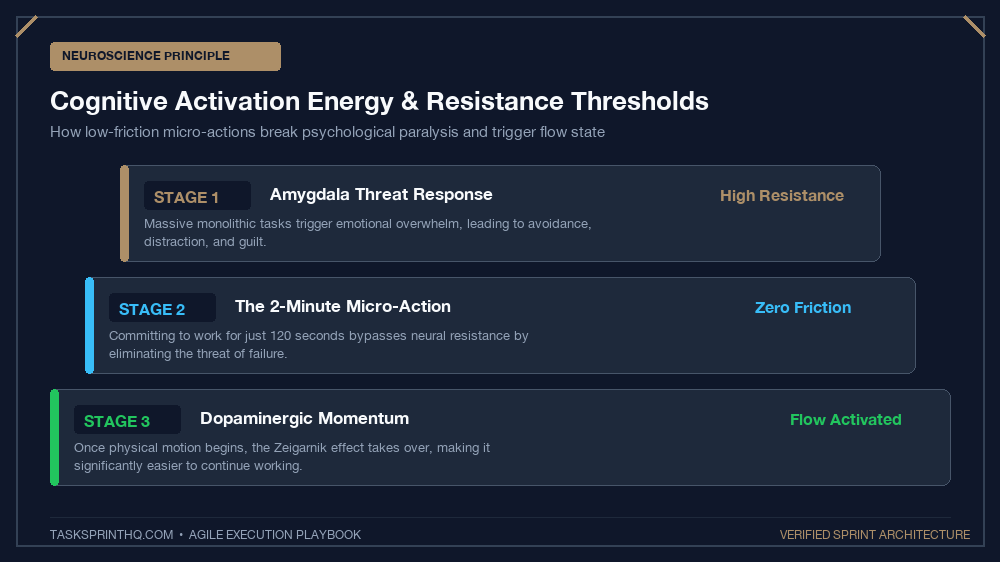
Contrary to common misconceptions, task paralysis is not laziness or a lack of moral willpower. It is an emotional self-regulation failure driven by neurobiology. When your conscious mind contemplates a monumental, ambiguous deliverable, your amygdala interprets the project as an impending threat of failure, social judgment, or cognitive discomfort.
According to behavioral psychology research summarized by James Clear in Atomic Habits, human behavior follows the principle of inertia: objects at rest tend to stay at rest. The primary friction of any difficult endeavor is concentrated entirely in the first one hundred and twenty seconds. Once physical action begins, the brain’s threat alarm disengages and dopamine pathways activate to reward progress.
The Activation Energy Rule:
Make the starting barrier so small that resistance is mathematically impossible. You are not committing to finishing the project; you are only committing to two minutes of low-stakes contact.
The 4-Step 2-Minute Kickstart Protocol
When you feel the heavy freeze of task paralysis settling over your morning sprint, immediately execute this four-step kickstart sequence:
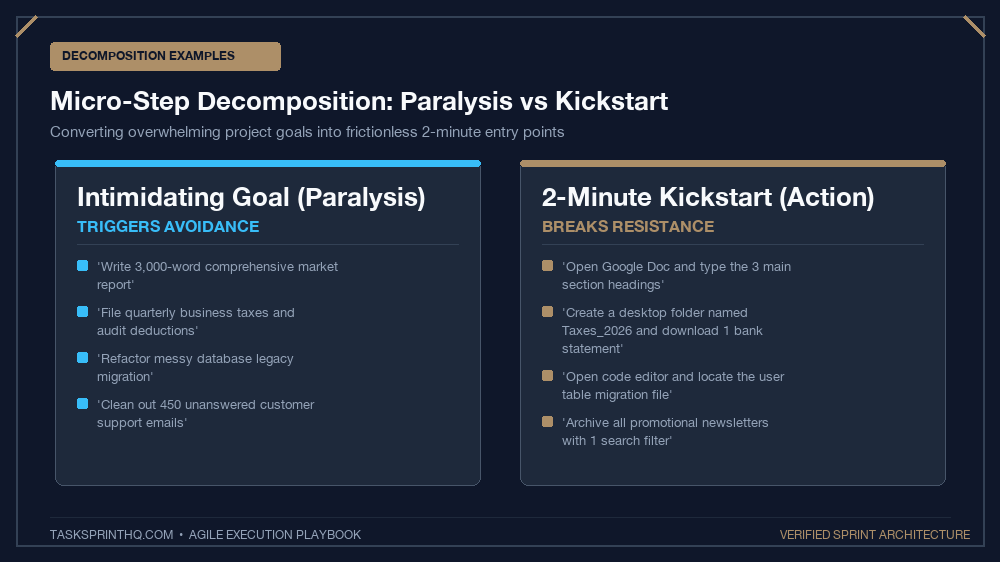
Step 1: The Micro-Slice Decomposition
Take the paralyzing deliverable and slice it down until you find an action that requires less than 120 seconds of physical effort. Look at how these daunting deliverables shrink into micro-actions:
- “Write 2,500-word client report” becomes “Open document and type 3 section headings.”
- “Refactor authentication database” becomes “Open terminal and create a new feature git branch.”
- “Prepare quarterly expense audit” becomes “Download PDF bank statement for September.”
Step 2: The Two-Minute Contract with Yourself
Explicitly promise yourself: “I will work on this micro-step for exactly two minutes. If I still feel intense dread when two minutes expire, I have full permission to stop and take a break.” Removing the requirement of completion disarms your amygdala’s threat response.
Step 3: Eliminate Environmental Interference
Close all unrelated browser windows, flip your phone face-down on your desk, and set a simple 2-minute timer on your watch or desktop app. If you use structured timers regularly, consult our comparison of timeboxing vs Pomodoro for deep work to understand how intervals regulate mental friction.
Step 4: Cross the Momentum Threshold
Begin typing or clicking. In over 85% of instances, once the timer expires at two minutes, you will naturally choose to continue. The psychological barrier has dissolved, your working memory is actively engaged, and you have smoothly transitioned into productive execution.
Real-World Kickstart Transformations
Examining how high-friction tasks convert into two-minute launch ramps shows why this method never fails:
| Paralyzing Deliverable | The Psychological Fear | 2-Minute Kickstart Micro-Action |
|---|---|---|
| Drafting Marketing Sales Page | “The copy won’t convert and my ideas are weak” | Write five bullet points describing the target customer problem |
| Cleaning Massive Code Debt | “Everything is tangled and I will introduce bugs” | Add code comments documenting three legacy function parameters |
| Sending Overdue Client Update | “The client will be frustrated by project delays” | Draft two polite sentences stating current staging progress |
Why “Micro-Steps” Outperform Raw Willpower
Willpower is a finite cognitive resource that depletes rapidly as your day progresses. Trying to force yourself through task paralysis through sheer grit triggers internal friction and builds resentment toward your work.
The 2-Minute Kickstart bypasses willpower altogether. It treats productivity as a physics problem: reducing the coefficient of friction makes movement effortless. Once you are in motion, continuing requires a fraction of the energy needed to start. Integrating this technique into your personal daily sprint framework ensures that morning freeze never ruins your scheduled deliverables.
What If You Actually Stop After Two Minutes?
Occasionally, you will complete your two minutes and still feel intense cognitive exhaustion or resistance. If that happens, honor your contract and stop. This diagnostic feedback indicates that the issue is genuine fatigue or severe scope ambiguity rather than simple inertia:
- Take a ten-minute walk to reset mental circulation.
- Ask whether the task’s instructions or requirements are truly clear; ambiguity is often disguised as paralysis.
- Decompose the task into even smaller components before attempting another sprint block.
Perfectionism: The Secret Engine of Task Paralysis
Underneath task paralysis lies a hidden psychological culprit: perfectionism. Knowledge workers often delay starting because they hold an idealized vision of the finished product. The fear that the opening paragraph will sound clumsy or that the initial database schema will be imperfect freezes action before the first keystroke.
The 2-Minute Kickstart functions as an explicit license to produce a messy, imperfect first draft. Lowering your standards for the first two minutes from “brilliant execution” to simply “making ink on paper” disarms your inner perfectionist critic. Once rough words or raw scaffolding exist on screen, editing and refining is emotionally effortless.
The 5-Day Kickstart Habit Stacking Protocol
If you suffer from chronic procrastination, build the kickstart ritual into your daily habits using habit stacking:
- Monday: Pair your kickstart with your first morning cup of coffee. As soon as the mug touches your desk, initiate your 2-minute countdown on your primary deliverable.
- Tuesday: Use the kickstart to transition immediately after your daily standup or morning planning ritual.
- Wednesday: Apply the kickstart right after lunch to overcome the post-meal afternoon slump.
- Thursday: Kickstart a dreaded administrative chore (like filing invoices) before leaving your desk.
- Friday: Use the 2-minute method to launch your weekly review and wrap up your sprint with momentum.
Break the Freeze Right Now
You do not need massive bursts of inspirational motivation to make extraordinary progress on your projects. Pick the single deliverable you have been dreading most today, isolate a tiny two-minute micro-action, start your countdown, and experience the liberating momentum of getting into motion.