When remote teams span twelve to sixteen hours of timezone difference—from San Francisco to Berlin and Tokyo—the traditional “pass the baton” workflow frequently collapses. An engineer in Seattle finishes work at 5:00 PM, sends a hasty Slack message reading “Pushed the changes, check it out”, and closes their laptop. Twelve hours later, a colleague in Sydney logs on, discovers broken environment variables and missing credentials, and remains completely blocked for an entire working day.
Implementing an airtight async handoff checklist different timezones require turns global distribution into a superpower rather than an obstacle. By replacing ambiguous chat messages with structured handoff documentation, your company unlocks the coveted “follow-the-sun” development cycle—where progress continues around the clock without delays.
The Follow-the-Sun Promise vs. The Handshake Gap
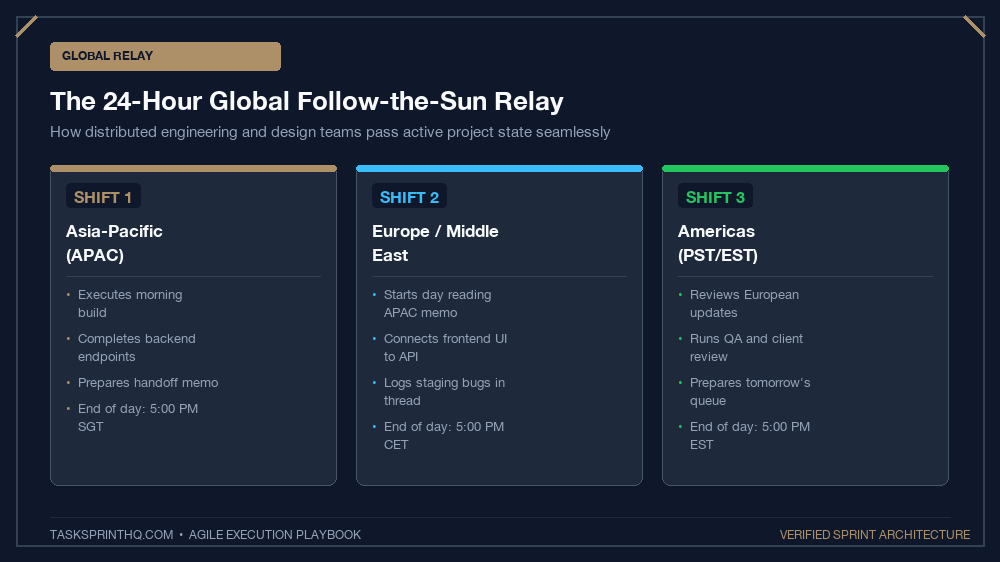
In theory, having engineers distributed across global timezones allows continuous 24-hour product velocity. While North America sleeps, Australasia builds; while Australasia rests, Europe tests. In practice, however, most organizations experience what remote work experts call the “Handshake Gap”.
According to all-remote leadership documentation from GitLab, asynchronous workflows succeed only when team members practice “low-context communication”—providing all necessary background information so the recipient can take immediate action without asking clarifying questions. When handoffs lack this depth, global distribution slows progress down rather than speeding it up.
The 12-Hour Golden Rule:
Always assume that by the time your colleague reads your handoff note, you will be sound asleep and completely unreachable. If your message leaves even one critical question unanswered, their entire workday will be wasted.
The 6-Step Async Handoff Checklist
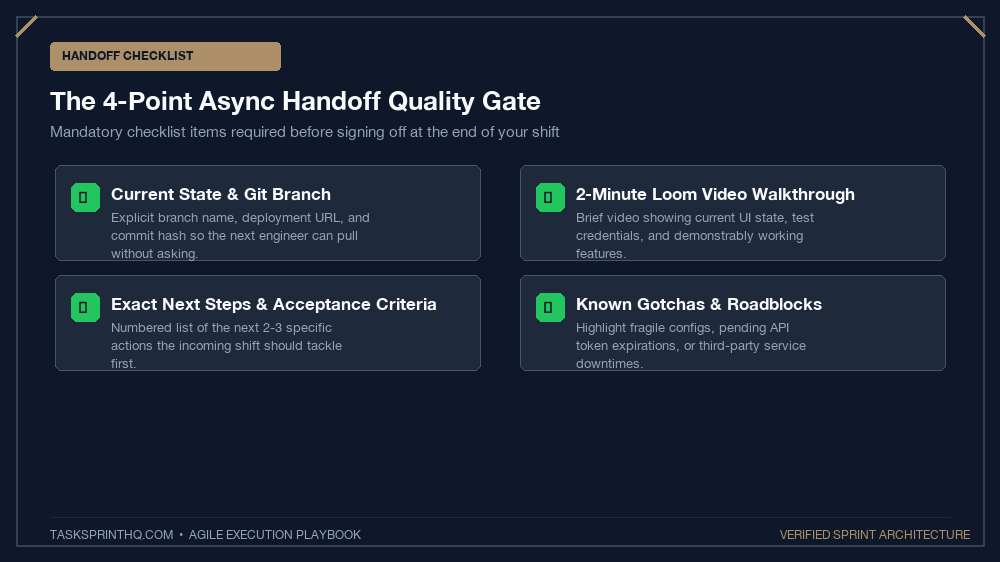
Before closing your workstation at the end of your shift, verify every outgoing project handoff against these six non-negotiable criteria:
1. Concrete State of Play (Where the Work Stands)
State exactly what was accomplished during your shift and what state the deliverable currently occupies. Specify the git branch name, PR number, or Figma frame link. State clearly whether the build is green or if specific test suites are failing.
2. The Exact Next Milestone (What Needs Doing)
Define the precise next objective for the incoming teammate. Never write “take a look”. Write: “Please review PR #302 focusing on the database migration rollback script, then deploy to staging.” If you want to refine how your team articulates tasks, consult our guide to writing clear task briefs that eliminate follow-up questions.
3. Staged Credentials & Access Tokens
Verify that all environment variables, test API tokens, and access rights are provisioned and stored in shared password vaults (1Password, Bitwarden). Never make a teammate wait twelve hours just to receive an API staging key.
4. Known Edge Cases and Landmines
Document any non-obvious quirks: “Note: The local Docker container currently fails if run on Node 18; ensure you use Node 20 as specified in the updated README.” Flagging known quirks saves hours of frustrating troubleshooting.
5. Asynchronous Loom Walkthrough (For Complex UI/UX)
If the handoff involves visual design, complex UX transitions, or intricate bug reproductions, record a 2-to-3-minute screen recording using Loom or Vidyard. A brief visual walkthrough communicates more context than ten paragraphs of text.
6. Cross-Functional Dependencies Log
Document whether this task touches other departments or upstream initiatives. If your feature relies on external API deliverables, align your handoff with our principles for managing project dependencies across remote teams.
Weak vs. Elite Async Handoff: A Side-by-Side Example
Examining the difference between a sloppy handoff and an elite handoff illustrates why projects stall or accelerate:
| Element | The Sloppy Handoff (Causes 24h Delay) | The Elite Handoff (Unlocks 24h Velocity) |
|---|---|---|
| Message Channel | Direct Slack message with zero context | Threaded comment directly on Linear/Jira ticket |
| Branch / Asset Link | “I pushed the branch, check github” | Direct markdown link to PR #142 (branch: feat/cart-tax) |
| Action Requested | “Let me know what you think” | “Run automated tests on Firefox, verify VAT rounding logic” |
| Credentials & Setup | Missing; colleague must guess test logins | Test credentials linked in 1Password shared team vault |
The Copy-Paste Async Handoff Card
Copy this standardized markdown template and embed it into your pull request descriptions or project management cards:
– **Current Branch / Asset:** `feat/checkout-redesign` (PR #89)
– **Status:** Core payment flow functional; unit tests passing.
– **Next Action Needed:** Audit mobile responsive layout on iOS Safari and review error state modals.
– **Test Credentials:** Stored under `Staging-Checkout-Test` in 1Password.
– **Known Quirk:** Stripe mock sandbox returns 402 if card #4242 is used with 2027 expiration; use 2028.
– **Loom Walkthrough:** [3-minute video overview link](https://loom.com/example)
– **Next Owner:** @Alex (Sydney team)
Establishing the “Morning Handoff Review” Ritual
Just as closing your shift requires writing a handoff, starting your workday requires reviewing incoming handoffs before opening email or social channels. Spend your first ten morning minutes reading incoming handoff cards, testing provided staging links, and confirming you have everything required to execute without blockers.
The Follow-the-Sun 3-Continent Rotation Cadence
Consider how a global software product team with nodes in San Francisco, London, and Tokyo coordinates a 24-hour development cycle:
- 08:00 PST (San Francisco): The California team logs on, reviews incoming pull requests and notes from Tokyo, and completes frontend UI development. At 17:00 PST, they file their async handoff card.
- 09:00 GMT (London): The UK team wakes up, receives the California handoff, and conducts comprehensive security audits and backend API integrations. At 17:30 GMT, they post their shift handoff note.
- 09:00 JST (Tokyo): The Japanese team takes over, runs automated integration tests, verifies multi-language localization, and prepares the production release candidate.
When each transition is anchored by our standardized handoff checklist, a three-day project is delivered in twenty-four continuous clock hours.
What to Do When a Handoff Fails
If an incoming contributor discovers missing credentials or vague instructions upon logging in, enforce the “Blocker Protocol”: immediately tag the outgoing shift lead, post an alert in the project channel, and pivot to a pre-approved secondary backlog task rather than spending hours guessing.
Turn Global Timezones into Your Greatest Advantage
Geographic distance does not have to create operational friction. By adopting this async handoff checklist for different timezones, your team transforms global dispersion into a continuous, 24-hour cycle of focused delivery and stress-free collaboration.