Knowledge work managers, product owners, and senior contributors spend an inordinate percentage of their workweeks answering the same frustrating questions: “What should happen when the user clicks this?”, “Where are the brand vector files?”, or “Is this copywriting approved for production?” Every clarifying message disrupts deep work and delays project momentum.
Mastering how to write clear task briefs no questions can interrupt this endless cycle of back-and-forth messaging. By framing requirements with surgical precision, providing complete operational context, and defining verifiable acceptance criteria, you enable team members and contractors to execute flawlessly on their very first attempt.
The True Cost of Ambiguous Task Briefs
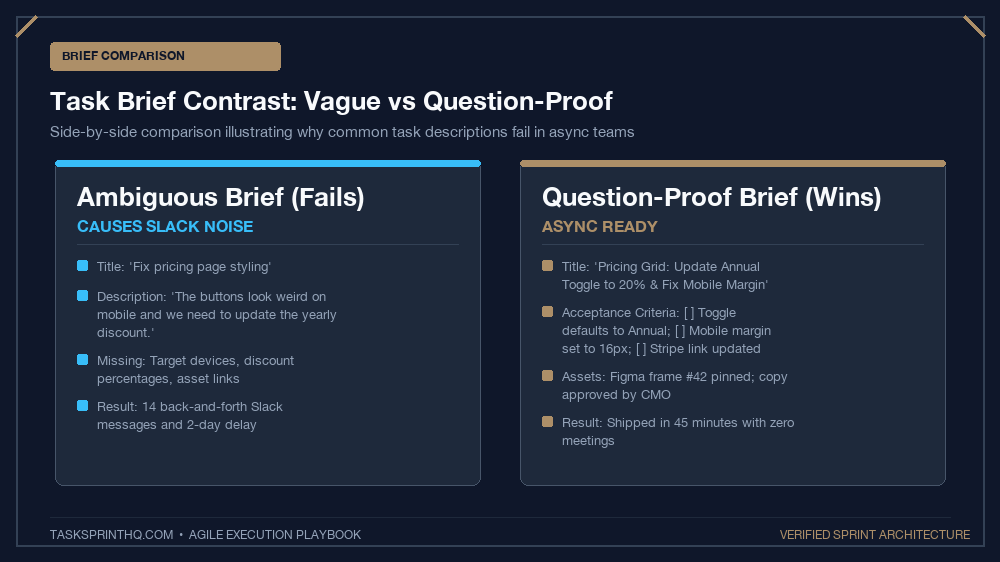
When a manager writes a hasty three-line task ticket—such as “Create customer onboarding flow”—they save five minutes of their own time at the expense of hours of team confusion. In an asynchronous or remote organization, ambiguity causes severe downstream damage:
- The 24-Hour Latency Penalty: In distributed teams across timezones, a single unanswered question causes a full 24-hour delay as work halts until the brief’s author comes online.
- Rework and Discarded Effort: Contributors make reasonable guesses to keep moving, only to be told during Friday review that their implementation doesn’t match the author’s unstated vision.
- Erosion of Autonomy: When briefs are perpetually vague, team members learn that taking initiative is dangerous, creating a culture of passive learned helplessness.
According to the product development framework published in Basecamp’s Shape Up, the secret to effective delegation is “shaping the pitch”—setting clear boundaries, defining the appetite, and removing rabbit holes before handing work to the builders.
The Complete Context Rule:
A task brief is complete only when a skilled contributor who has never met you can execute the work to perfection without sending a single Slack message or booking a clarification call.
The 5 Pillars of a Zero-Ambiguity Task Brief
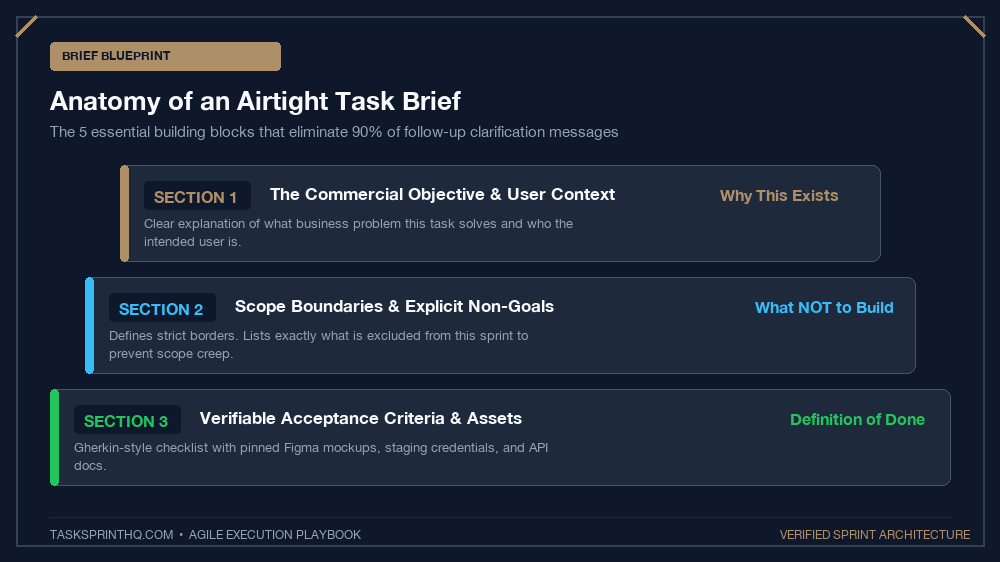
Every high-impact task brief must incorporate these five structured components:
1. The Problem Statement & Business Why
Never explain what to build without explaining why it matters. State the underlying business pain point or user struggle. When contributors understand the overarching goal, they make intelligent micro-decisions when encountering unexpected edge cases.
2. The Appetite & Constraints (What We Are NOT Doing)
Boundaries are more important than feature lists. Define the “appetite”—how much time and complexity this task warrants (e.g., “This is a 4-hour quick win, not an enterprise overhaul”). Explicitly list out-of-scope items to prevent scope creep.
3. Binary Acceptance Criteria (Given / When / Then)
Acceptance criteria must be objective, verifiable facts, not subjective opinions. Use the industry-standard Given/When/Then formulation:
- Given: A registered user clicks the “Export CSV” button.
- When: The dataset contains more than 1,000 rows.
- Then: The UI displays a background processing toast alert and emails a download link within 60 seconds.
4. Staged Assets, Credentials & Reference Links
Embed direct links to every supporting artifact directly inside the card:
- Figma design frames and vector asset libraries.
- Copy documents with approved headlines and body text.
- Staging credentials, API documentation, or webhook endpoints.
If the task requires coordinated sequencing across multiple team members, ensure you configure it using our guidelines on preventing workflow bottlenecks with Asana task dependencies.
5. The Verifiable Definition of Done (DoD)
Define what the finished handoff looks like. Does it require a passing automated test suite? A 2-minute Loom walkthrough? Deployment to a staging URL? Make the finish line unmistakable. If the deliverable involves a shift transition, follow our async handoff checklist for different timezones to guarantee seamless reception.
Weak Brief vs. Zero-Ambiguity Brief: Real Comparison
Comparing a typical hasty ticket with an engineered brief illustrates why clear documentation saves days of wasted time:
| Brief Section | Vague Ticket (Sparks 6 Follow-Up Questions) | Engineered Brief (Zero Questions) |
|---|---|---|
| Title | “Update pricing page” | “Add Annual Billing Toggle with 20% Discount Badge to Pricing Matrix” |
| Context | “Sales says we need annual plans” | “Q3 priority: improve ARR cash collection by incentivizing annual upfront billing.” |
| Scope Boundaries | None specified | “OUT OF SCOPE: Do not modify enterprise custom tier. Do not alter Stripe billing webhooks.” |
| Verification | “Make sure it works” | “1. Toggle switches price numbers dynamically. 2. Stripe checkout session correctly passes annual plan ID.” |
The Universal Task Brief Template
Copy and paste this markdown skeleton into your project management templates (Jira, Linear, ClickUp, or Asana):
– **Goal:** [What problem are we solving?]
– **Impact Metric:** [How does this move our business KPIs?]
## 🚫 Boundaries & Non-Goals
– **Appetite:** [Estimated effort: e.g., 4 Hours]
– **Out of Scope:** [What are we explicitly NOT building?]
## ✅ Acceptance Criteria
– [ ] Given [precondition], When [action], Then [expected result]
– [ ] Mobile responsive audit completed on iOS / Android
## 🔗 Staged Resources
– Figma: [Link to Frame]
– Copy Doc: [Link to Google Doc]
– Credentials: Stored in shared 1Password vault
## 🏁 Definition of Done
– Code merged to staging branch with green CI tests
– 2-minute Loom walkthrough posted in ticket comments
The 2-Minute Pre-Publish Audit
Before hitting ‘Publish’ on any new task card, spend two minutes performing the “Cold Eyes Read”: read your brief from the perspective of an external contractor living in a different timezone. Does the brief make hidden assumptions? Are file permissions public? Fixing omissions before publishing saves everyone hours of frustration.
The ‘Definition of Ready’ (DoR) Gatekeeper Rule
The single greatest operational lever for improving task brief quality is empowering individual contributors to reject poorly written tickets. Establish a formal team agreement: if a ticket enters the sprint without explicit acceptance criteria, staged assets, or a clear business goal, the assigned developer or designer has explicit permission to apply a Needs Clarification label and send it back to the author.
Once product managers realize that unrefined tickets will not be executed until they meet the team’s documentation standards, the quality of incoming briefs improves across the entire department almost overnight.
The 30-Second Glance Test
Before moving any task card into an active sprint, subject it to the 30-Second Glance Test: can an engineer skim the card for thirty seconds and immediately know what file, URL, or asset needs modification? If they have to search through separate Slack channels or Google Drive folders to find basic inputs, the brief has failed the test.
Write Better Briefs, Move 10x Faster
Investing ten focused minutes to craft an exceptional task brief pays exponential dividends across your entire team. Eliminate clarifying friction, empower your colleagues to do their best work, and experience the extraordinary speed of zero-question asynchronous execution.